
Odisha Property Benchmark Value: Find It & Why It Matters
The Odisha government sets the minimum value for property transactions, known as the benchmark value, to calculate stamp duty and registration fees. You can find this official minimum value online through the Inspector General of Registration (IGR) Odisha website.
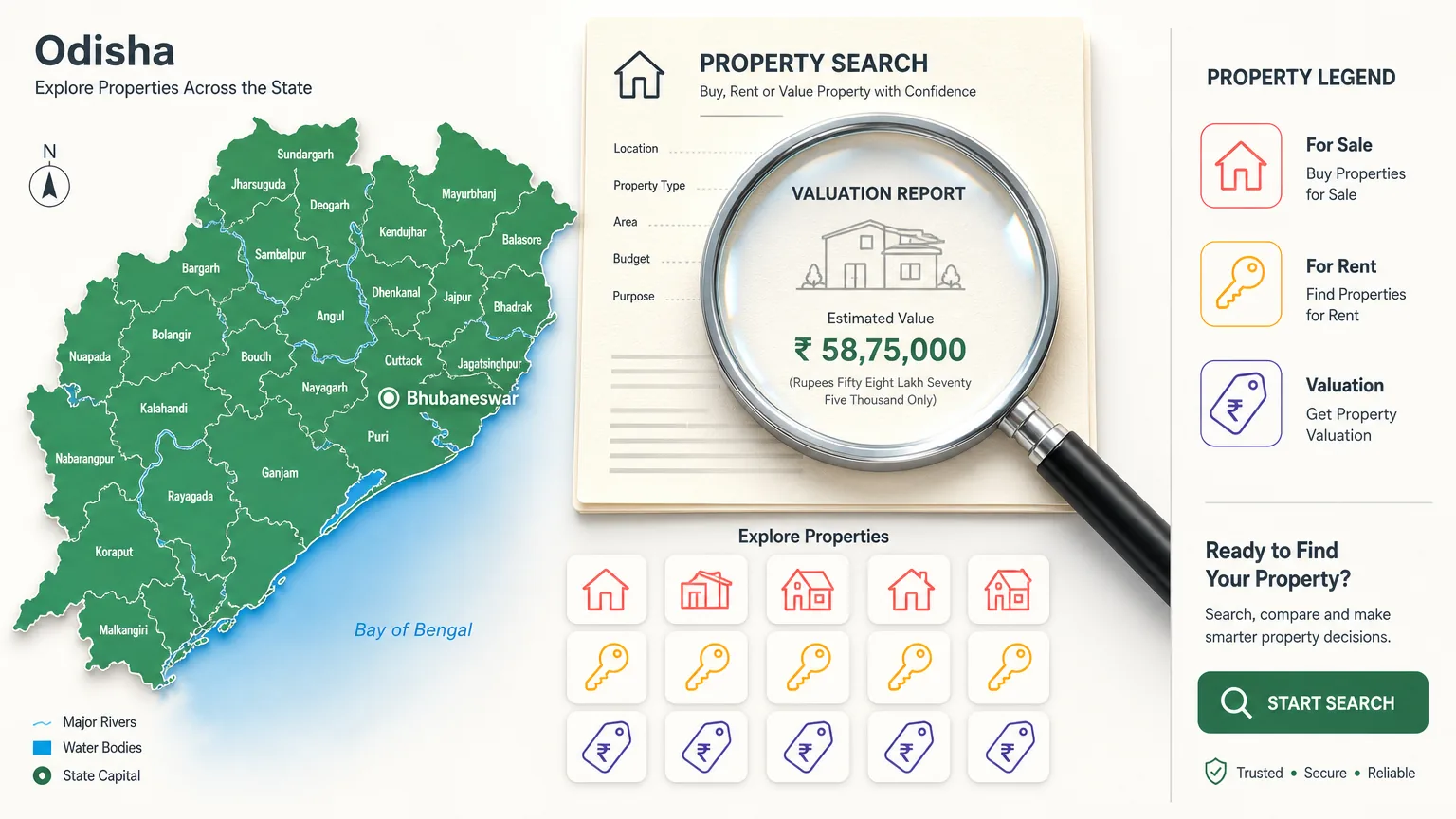
The Odisha government sets the minimum value for property transactions, known as the benchmark value, to calculate stamp duty and registration fees. You can find this official minimum value online through the Inspector General of Registration (IGR) Odisha website.
What is the official minimum property value in Odisha?
The official minimum rate at which a property can be registered in a specific area of Odisha is called the benchmark value. This value is also known as Guideline Value, Circle Rate, or Ready Reckoner Rate in other states. The main purpose of the benchmark value is to calculate the stamp duty and registration charges for a property transaction. It also helps prevent property undervaluation, which can be attempted to avoid paying fair taxes.
Why is knowing the official minimum property value important for me?
Understanding the official minimum property value has several direct implications for you. Its primary use is calculating stamp duty and registration fees. The stamp duty and registration fees are percentages of the higher of two values: either the benchmark value or the actual price you agreed to pay for the property. For example, if the benchmark value is ₹50 lakhs and you buy the property for ₹45 lakhs, you still pay stamp duty based on ₹50 lakhs. The benchmark value can also be a data point banks consider when assessing a property's worth for a loan, even though banks conduct their own detailed valuations. The benchmark value plays a role in capital gains tax calculations under the Income Tax Act. If you sell a property for less than its benchmark value, the Income Tax Department might consider the benchmark value as your sale price for tax purposes.
How can I find the official minimum property value for a property in Odisha online?
Finding the official minimum property value is straightforward using the official government portal. First, open your web browser and navigate to www.igrodisha.gov.in, which is the official portal for the Inspector General of Registration, Odisha. On the homepage, look for a section or link titled "Benchmark Valuation" or "Valuation" and click on it. You will then see dropdown menus where you select the district where your property is located, the relevant Registration Office (Sub-Registrar Office), and the specific Village or Thana (police station area) that covers your property. The portal will ask for specific property identifiers, so enter the Plot Number (also known as Khasra number) and the Khata Number (account number detailing land ownership), which are usually found on your property documents. After entering the details, click "Submit" or "View Valuation." The system will display the benchmark valuation per unit (for example, per decimal for land or per square foot for built-up areas) for that specific plot, and you will need to multiply this rate by your property's area to get the total benchmark value.
What factors determine the official minimum property value in Odisha?
The Odisha government considers several factors when it sets these minimum rates. The location of the property is a factor, as properties in urban areas, near main roads, or in well-developed localities generally have higher benchmark values than those in rural or less accessible areas. The type of property is also a factor, with rates differing significantly for residential plots, commercial spaces, industrial land, and agricultural land, and commercial properties usually having higher rates. Available infrastructure and amenities, such as proximity to essential services like good roads, water supply, electricity, schools, hospitals, and parks, can increase the benchmark value. While benchmark values are not as dynamic as market values, the government does consider general property price trends in the region when updating these rates.
Is the official minimum property value the same as the market value?
No, the official minimum property value is not the same as the market value. This is a crucial distinction. The benchmark value is a government-set minimum value primarily for tax purposes. It is a floor price below which a property cannot be officially registered. It helps the government collect stamp duty and registration fees and curb black money transactions. The market value is the actual price a willing buyer would pay to a willing seller in the open market, assuming both are well-informed and under no compulsion to buy or sell.
The benchmark value and market value differ in purpose. The benchmark value is for taxation and regulation. The market value reflects real-world demand and supply. They also differ in dynamics. The market value is highly dynamic, fluctuating daily based on economic conditions, local demand, property condition, buyer interest, and negotiation. Benchmark values are updated much less frequently, typically once a year or every few years. The market value often, and usually significantly, exceeds the benchmark value. A property's unique features, recent developments in the area, or a strong buyer demand can push its market value far beyond the government's minimum. For a deeper understanding of how these values are determined, you can read more about [benchmark value] in property valuation.
When do I need a professional market valuation instead of just the official minimum value?
While the government's benchmark value is essential for stamp duty calculations, it does not reflect your property's true worth. For an accurate assessment, you need a professional market valuation. You will need one for accurate pricing. If you are selling, you need to know what your property is truly worth to set a competitive price. If you are buying, an independent valuation helps ensure you are not overpaying.
A professional market valuation is also needed for capital gains tax. When selling a property, especially one held for many years, you need an accurate Fair Market Value (FMV) as of April 1, 2001 (or other relevant dates) to calculate your capital gains tax correctly. The benchmark value alone is not enough, and the Income Tax Department requires a report from a government-approved valuer. For example, consider a property purchased in 1995 for ₹5 lakhs. Its benchmark value in 2001 was ₹10 lakhs, and its market value in 2001, as determined by a professional valuer, was ₹15 lakhs. If you sell it today for ₹80 lakhs, the Income Tax Department will use the higher of the benchmark value or the professionally valued market value from 2001 as the cost basis for capital gains calculation, which in this case would be ₹15 lakhs. This significantly reduces your taxable gain compared to using the original purchase price.
Banks and financial institutions always require a certified valuer's report to assess the property's market value before approving a loan against it. For instance, a bank might receive a loan application for a property with a benchmark value of ₹60 lakhs. However, their internal valuation, conducted by a certified valuer, might assess the market value at ₹90 lakhs. The bank will base its loan approval and amount on the ₹90 lakh market value, not the lower benchmark. For legal disputes, such as family settlements, divorce proceedings, or property disputes, an impartial, certified valuation report from a neutral expert is legally required and accepted by courts. To ensure your property is adequately insured for its replacement cost, an accurate market valuation is vital for insurance purposes. If you are making significant investment decisions, you need real-world value insights, not just a tax baseline, for investment analysis.
Rao Valuers are government-approved and IBBI registered property valuers operating across India. Rao Valuers has 35 years of experience, and their reports are accepted by banks, the Income Tax Department, and courts. Getting a valuation report might seem like an added cost, but it is an investment that can save you significant money in taxes or prevent future legal complications. Rao Valuers' reports go through banks, tax offices, and courts without coming back with questions.
This article provides general guidance only and is not a substitute for professional legal or financial advice. Always consult with a qualified professional for advice tailored to your specific situation.
For an accurate and certified market valuation by a government-approved valuer, contact Rao Valuers for a detailed assessment. Rao Valuers' credentials include IBBI/RV/02/2019/10843 and CAT-I/443/117/2000-01.
Author: Certified Valuer and Property Consultant with Rao Valuers.
Checked by Parish Rao, Chartered Engineer and Government Approved Valuer (Registration number CAT-I/443/117/2000-01).
Page last checked on 8 November 2026.
Get a free valuation quote
Tell us what you need valued. We will message you on WhatsApp with which report you need and what it costs, free of charge.
In a hurry? Call +91 98681 69747 instead.