
Land Valuation in India: A Complete Guide for 2026
You have a piece of land, maybe inherited agricultural land on the city's edge, or a non-agricultural plot you are thinking of selling. You are not a real estate expert, and the advice you are getting from brokers and family feels confusing. You need to know the real value of your land, not just a guess.

How is the Value of Land Determined in India? A Complete Guide
You have a piece of land, maybe inherited agricultural land on the city's edge, or a non-agricultural plot you are thinking of selling. You are not a real estate expert, and the advice you are getting from brokers and family feels confusing. You need to know the real value of your land, not just a guess. You also need to understand why a formal, government-approved valuation is important for your financial and legal security, especially if you are selling and need to calculate capital gains tax correctly.
What Exactly is Land Valuation and Why Do You Need It?
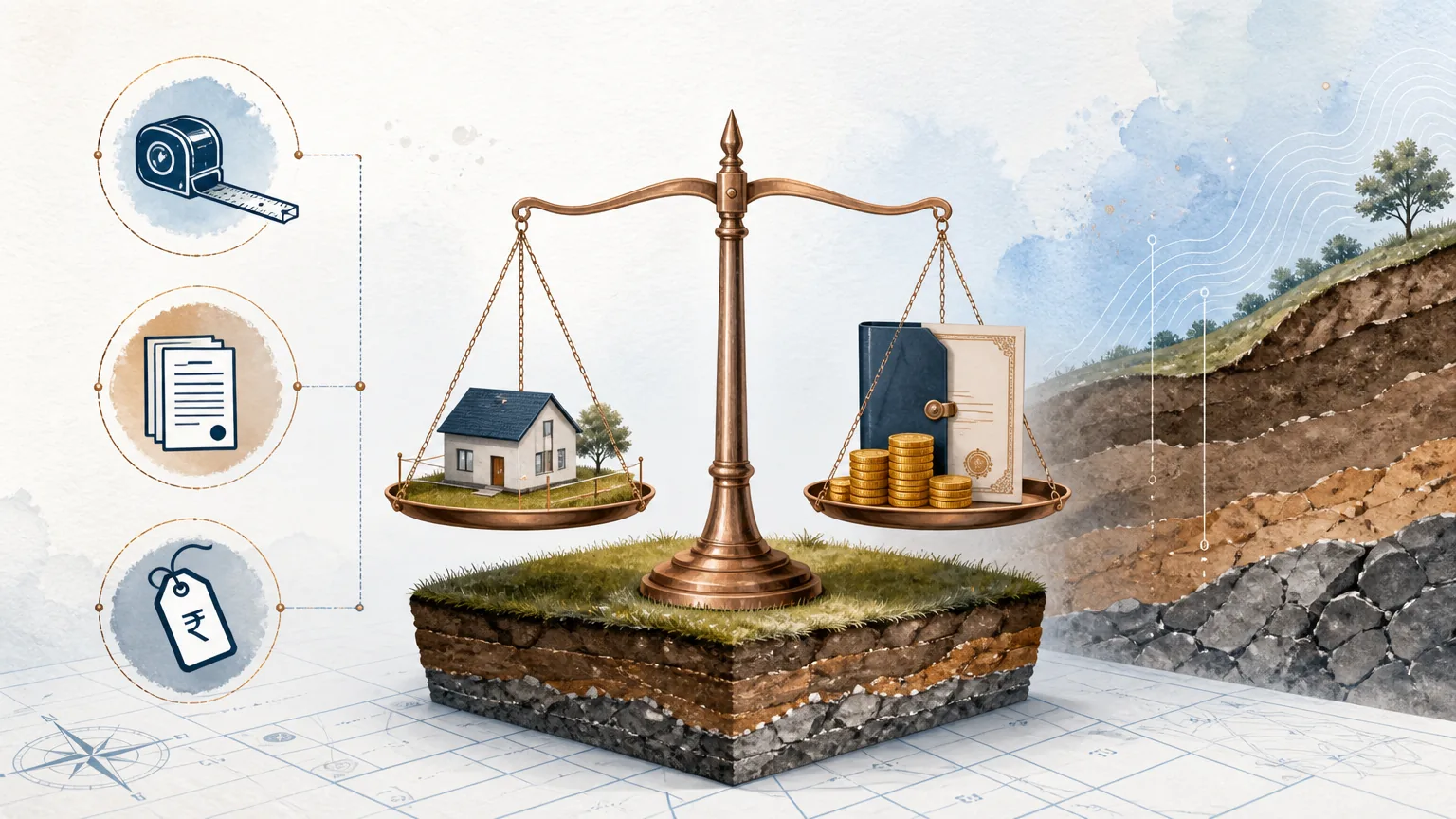
"I hear this term, but what does it really mean? Is it just guessing a price?"
Land valuation is a professional and systematic process to determine the fair market value of a piece of land at a specific time. It is not guesswork. Instead, it is a data-driven assessment. Experts use established methods and consider many factors to arrive at an objective value.
You need a professional land valuation for several important reasons:
- Buying or Selling Property: To ensure you are paying or receiving a fair price.
- Securing Loans: Banks and financial institutions require a valuation for mortgages or loans against property.
- Legal & Tax Purposes: This includes calculating capital gains tax, wealth tax, or for income tax returns (Schedule AL). For capital gains, an accurate valuation as of April 1, 2001, can significantly reduce your tax liability. Our team successfully navigated a complex capital gains tax calculation for a client selling inherited land in Mumbai, reducing their tax burden by accurately valuing the property as of April 1, 2001.
- Family Settlements & Inheritance: To divide assets fairly among heirs.
- Government Acquisition: To ensure you receive fair compensation if the government acquires your land.
- Investment & Development Decisions: To assess the feasibility and potential returns of a project.
What are the Main Methods Used for Land Valuation in India?
"How do experts actually calculate the value? Is there a formula?"
There is not one single formula for land valuation. Instead, valuers use several established methods, choosing the most appropriate one based on the type of land and its purpose.
Method 1: Comparison Method
This is the most common method. The value of your land is determined by comparing it to similar properties that have recently been sold in the same locality. Key comparison factors include:
- Size and Shape: How big is the plot, and is it a regular shape?
- Location: Its specific position within the area.
- Date of Sale: Recent sales are more relevant than older ones.
- Usage: Whether the comparable property was agricultural, residential, or commercial.
Method 2: Development Method (or Residual Method)
This method is used for land with development potential, such as a plot where an apartment building could be constructed. The valuer estimates the final value of the developed property and then subtracts all costs associated with development, such as construction, marketing, and the developer's profit. The remaining "residual" value is attributed to the land itself.
Method 3: Belting Method
Often used for large tracts of land, especially agricultural land, this method divides the land into "belts" or zones. The belt closest to a main road or access point is valued highest due to its accessibility and potential for commercial use. Subsequent belts, further away from the main access, are valued progressively lower. In a recent valuation of a 5-acre agricultural plot in Haryana, we observed that the 1-acre belt bordering the state highway was valued at 1.5 times the per acre value of the interior 4 acres, due to its direct road access and commercial potential.
What Key Factors Influence the Value of Your Land?
"My land is near a new highway. Does that matter? What should I be looking at?"
Many factors influence your land's value. Understanding these helps you appreciate the valuation process:
- Location & Accessibility: Proximity to major roads, highways, markets, schools, hospitals, and public transport hubs significantly impacts value. A new highway nearby can certainly increase your land's worth. For example, a plot of land in Bangalore's Outer Ring Road area, due to its proximity to IT hubs and excellent connectivity, might command 2 to 3 times the value of a similar sized plot just 10 km away in a less developed area.
- Size & Shape: Generally, large plots with a regular, rectangular shape are more valuable and easier to develop than irregular or smaller ones.
- Zoning & Land Use Regulations: This is a major determinant. Is your land zoned for residential, commercial, industrial, or agricultural use? What are the Floor Space Index (FSI) or Floor Area Ratio (FAR) regulations for your area? These dictate how much you can build on the land. For instance, a 1000 sq ft plot zoned for commercial use with an FSI of 3.0 could potentially yield 3000 sq ft of built-up area, making it significantly more valuable than a residential plot of the same size with an FSI of 1.0, which would only allow 1000 sq ft of built-up area.
- Physical Attributes: The type of soil, the land's topography, and the risk of natural calamities like flooding all affect value.
- Infrastructure: The availability and quality of essential services like water, electricity, and drainage are crucial. A plot with immediate access to municipal water and sewage lines can be valued 15-20% higher than a similar plot requiring borewells and septic tanks.
- Future Development: Proximity to planned government projects like new highways, metro lines, or special economic zones (SEZs) can significantly boost future value.
- Legal Status: A clear title that is free from encumbrances or legal challenges is paramount. Any legal issues can drastically reduce value.
- Market Demand & Supply: High demand and low supply in a particular area will drive up land prices.
- Economic Conditions: General economic growth and interest rates influence the real estate market.
What is the Difference Between Guideline Value and Market Value?
"The government website shows a 'circle rate' for my area. Is that my land's value?"
This is a common point of confusion, especially when you are selling property and need to calculate capital gains tax.
- Guideline Value (Circle Rate/Ready Reckoner Rate): This is the minimum value at which a property can be registered with the government. State governments set these rates to calculate stamp duty and registration charges. In Delhi, it is called the "Circle Rate," while in Maharashtra, it is the "Ready Reckoner Rate." These rates are typically updated periodically by the respective State Revenue Departments.
- Market Value: This is the actual price your land is likely to fetch in the open market between a willing buyer and a willing seller, assuming both have full knowledge of the property and are acting without undue pressure.
The Key Difference: Market Value is almost always higher than the Guideline Value. Relying solely on the Guideline Value when selling can lead to significant financial loss. For capital gains tax calculations, the Income Tax Department often requires a valuation report that reflects the fair market value, especially for properties purchased before April 1, 2001. If you declare a sale price lower than the market value, you risk receiving a notice from the IT department.
> Work with Rao Valuers
>
> Get a free valuation quote →
Why Should You Hire a Government-Approved Valuer?
"My local broker says he can give me a valuation. Why pay someone else?"
While a local broker can give you an estimate, it is crucial to understand why a government-approved valuer is essential, especially for legal, tax, or financial purposes.
Rao Valuers provides government-approved and IBBI registered property valuation reports across India. Our valuers hold certifications as Registered Valuers under the Insolvency and Bankruptcy Board of India (IBBI), which is the primary regulatory body for valuation professionals in India. Our registration numbers, such as IBBI/RV/02/2019/10843 and CAT-I/443/117/2000-01, signify our compliance with the stringent standards set by the government.
- Credibility & Acceptance: Reports from government-approved valuers are required by banks, courts, and government bodies like the Income Tax Department. A broker's estimate is not a legal document and will not be accepted for official purposes. For example, under the Income Tax Act, 1961, Section 50C, if the sale consideration is less than the stamp duty value, the stamp duty value is considered for capital gains purposes. A formal valuation report from an approved valuer can help justify the actual market value.
- Objectivity & Unbiased Assessment: A professional valuer provides an impartial value based on facts and established methodologies. They have no vested interest in the sale price, unlike a broker who might push for a quick transaction.
- Expertise & Due Diligence: Approved valuers are qualified professionals who conduct thorough research, site visits, and legal checks that an informal assessment would miss. They understand the nuances of various valuation methods and local regulations.
- Risk Mitigation: A certified valuation report is a legal document that protects you. It safeguards you from future disputes and tax scrutiny, and it ensures you do not undervalue your asset, which is critical for calculating capital gains tax correctly.
- Compliance: For specific needs, such as immigration visas or court matters, only reports from government-approved valuers are accepted. Our reports are accepted by embassies worldwide for visa applications, ensuring your asset declaration is officially recognized.
What is the Land Valuation Process with Rao Valuers?
"Okay, I am convinced. What happens next? How does this work?"
At Rao Valuers, we make the process clear and straightforward. With 35 years of experience and government approval, our reports are accepted by all major institutions.
1. Initial Consultation & Document Submission: You contact us, and we will guide you on the necessary documents, such as your title deed and survey plan. For properties bought before April 1, 2001, this is especially important for capital gains calculations.
2. Site Inspection: Our certified valuer visits your property to assess its physical characteristics and the surrounding neighborhood. This is a critical step for an accurate valuation.
3. Data Analysis & Valuation: We conduct thorough research by analyzing comparable sales data and local regulations. We apply the most appropriate valuation methods to determine your land's fair market value.
4. Report Preparation: We compile all findings into a comprehensive valuation report. This report meets all legal and banking standards and is accepted by the Income Tax Department, courts, and financial institutions.
5. Report Delivery & Explanation: We deliver the final report, typically within 48 to 72 hours, and are available to answer any questions you may have about its contents.
Ready to know the true value of your land for your capital gains tax, loan, or any other need? Contact Rao Valuers today for a consultation with our government-approved experts across India. We provide unbiased and accurate land valuations, ensuring your financial and legal security.
Checked by Parish Rao, Chartered Engineer and Government Approved Valuer (Registration number CAT-I/443/117/2000-01).
Page last checked on 8 November 2026.
Get a free valuation quote
Tell us what you need valued. We will message you on WhatsApp with which report you need and what it costs, free of charge.
In a hurry? Call +91 98681 69747 instead.