
Two Values on Your Property Report? Here's Why
A property valuation report often includes two distinct values: Fair Market Value and Distress Sale Value. These values provide a comprehensive financial picture of a property for various situations, such as loan applications or legal settlements.
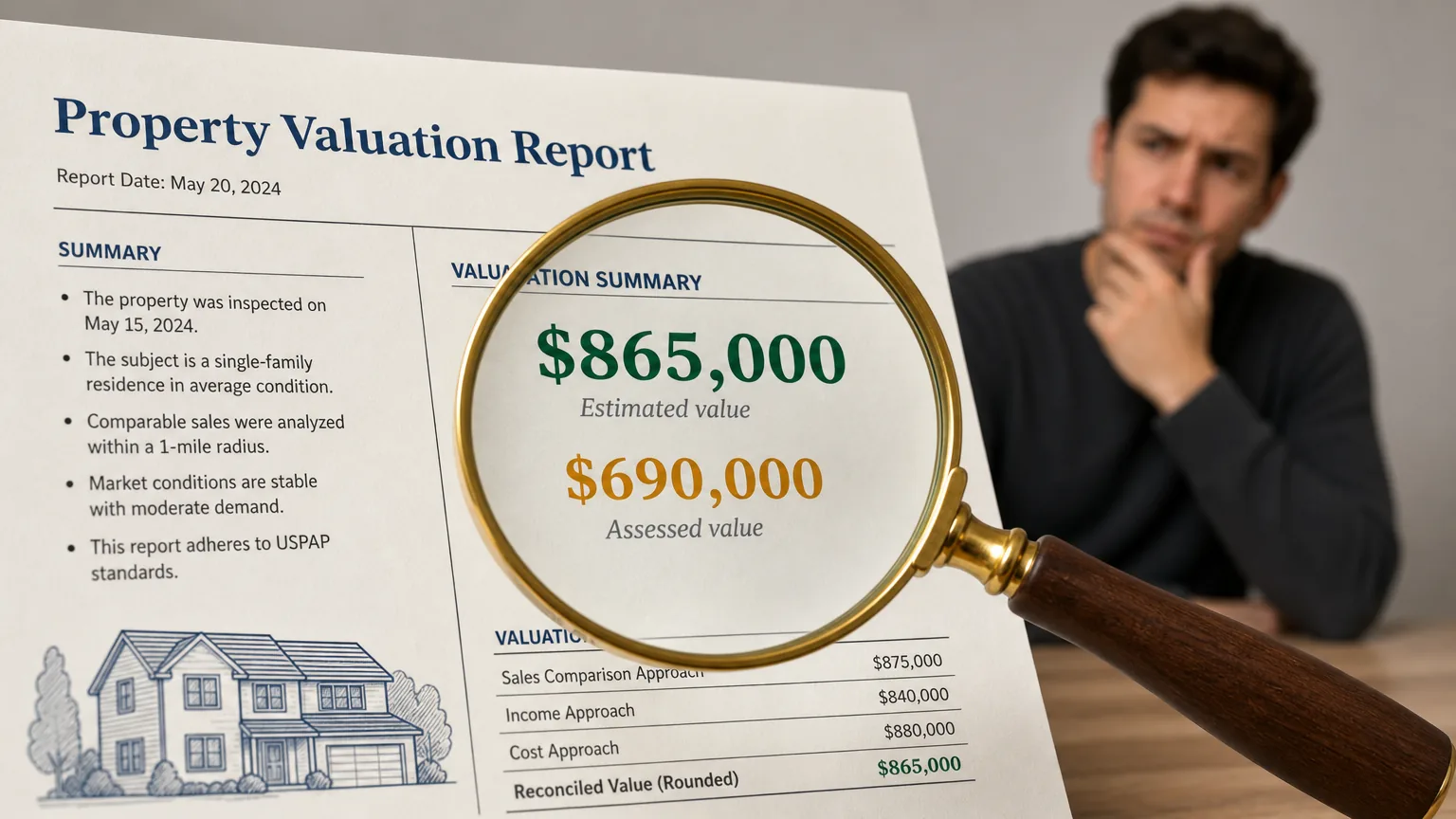
A property valuation report often includes two distinct values: Fair Market Value and Distress Sale Value. These values provide a comprehensive financial picture of a property for various situations, such as loan applications or legal settlements.
Why does a property valuation report show two values?
A property valuation report shows two values, Fair Market Value and Distress Sale Value, to provide a complete financial assessment for different scenarios. The Fair Market Value represents the property's worth in a normal, unhurried sale, while the Distress Sale Value indicates its price under urgent sale conditions.
What is Fair Market Value?
Fair Market Value is the estimated price a property would likely sell for on the open market under normal conditions. This value assumes a willing buyer and a willing seller, neither under pressure to act quickly. It also assumes a reasonable marketing period for the property. Both buyer and seller are informed about the property and current market conditions. Rao Valuers calculates this value based on recent sales of similar properties in the area, the property's condition, location, size, and current real estate trends.
For example, if a 2 BHK apartment in a prime Mumbai locality, with similar features and age, recently sold for INR 1.5 Crore after being on the market for three months, its Fair Market Value would likely be around INR 1.5 Crore. This reflects a transaction where both parties had ample time to negotiate and assess the market.
What is Distress Sale Value?
Distress Sale Value is the estimated price a property would likely sell for if it had to be sold very quickly, under pressure or compulsion. This value assumes the seller needs to liquidate the asset urgently, perhaps due to financial trouble or a loan default. The marketing and sale period is extremely short, not allowing for extensive negotiations or waiting for the best offer. Buyers know the seller is in a hurry, which often leads to them offering a lower price. This value is typically a percentage of the Fair Market Value, reflecting the discount for a quick sale.
Continuing the example, if the owner of that same Mumbai apartment needed to sell it within two weeks due to an urgent financial requirement, they might have to accept a Distress Sale Value of INR 1.2 Crore. This 20% reduction from the Fair Market Value reflects the significant pressure to sell quickly, where buyers capitalize on the seller's urgency. Professional valuation standards, such as those set by the International Valuation Standards Council (IVSC), acknowledge that forced sale conditions can significantly impact value.
Why do banks and lenders need both values?
Banks and lenders need both Fair Market Value and Distress Sale Value to assess their risk when considering a loan. The Fair Market Value shows the property's potential. The Distress Sale Value shows their worst-case scenario. Banks primarily use the Fair Market Value to determine the loan amount they can offer (the Loan to Value, or LTV ratio). They want to know what the property is worth in a normal sale. Lenders also need the Distress Sale Value. This tells them how much they could realistically recover quickly if a borrower were to default on the loan and the property had to be auctioned off in a hurry. This dual value approach is a mandatory part of risk management for all regulated financial institutions in India. The Reserve Bank of India (RBI) guidelines for asset classification and provisioning norms for banks implicitly require a thorough assessment of recoverable value, which the Distress Sale Value provides. It protects the bank from losses and helps ensure the stability of the financial system.
Which value matters most for my situation?
The value that matters most depends entirely on your specific situation.
- For Selling Your Property (No Rush): Focus on the Fair Market Value. This is your target selling price.
- For Applying for a Loan: Both values matter. The Fair Market Value is used to calculate your eligible loan amount. The Distress Sale Value is for the bank's internal risk assessment.
- For Legal or Family Settlements: The Fair Market Value is almost always the standard for equitable division of assets. Legal precedents in Indian courts for property division, particularly in matrimonial disputes, typically rely on the Fair Market Value to ensure a just and equitable distribution.
How does Rao Valuers provide clarity in valuation reports?
Rao Valuers provides clarity in valuation reports by including multiple values, which signifies a thorough and compliant assessment. A professional valuation report with multiple values empowers you and your lender to make informed financial decisions. Rao Valuers has 35 years of experience and government approval. Their reports go through banks, tax offices, and courts without coming back with questions.
If you have questions about your Rao Valuers report or need a government-approved valuation for any purpose across India, contact their expert team for guidance.
Checked by Parish Rao, Chartered Engineer and Government Approved Valuer (Registration number CAT-I/443/117/2000-01).
Page last checked on 8 November 2026.
Get a free valuation quote
Tell us what you need valued. We will message you on WhatsApp with which report you need and what it costs, free of charge.
In a hurry? Call +91 98681 69747 instead.