
Capital Gain on Inherited Property in India: A Guide
Inheriting a property can be a significant life event, bringing both emotional weight and financial considerations. While the act of inheriting property itself is not taxed in India, the moment you decide to sell it, capital gains tax comes into play.
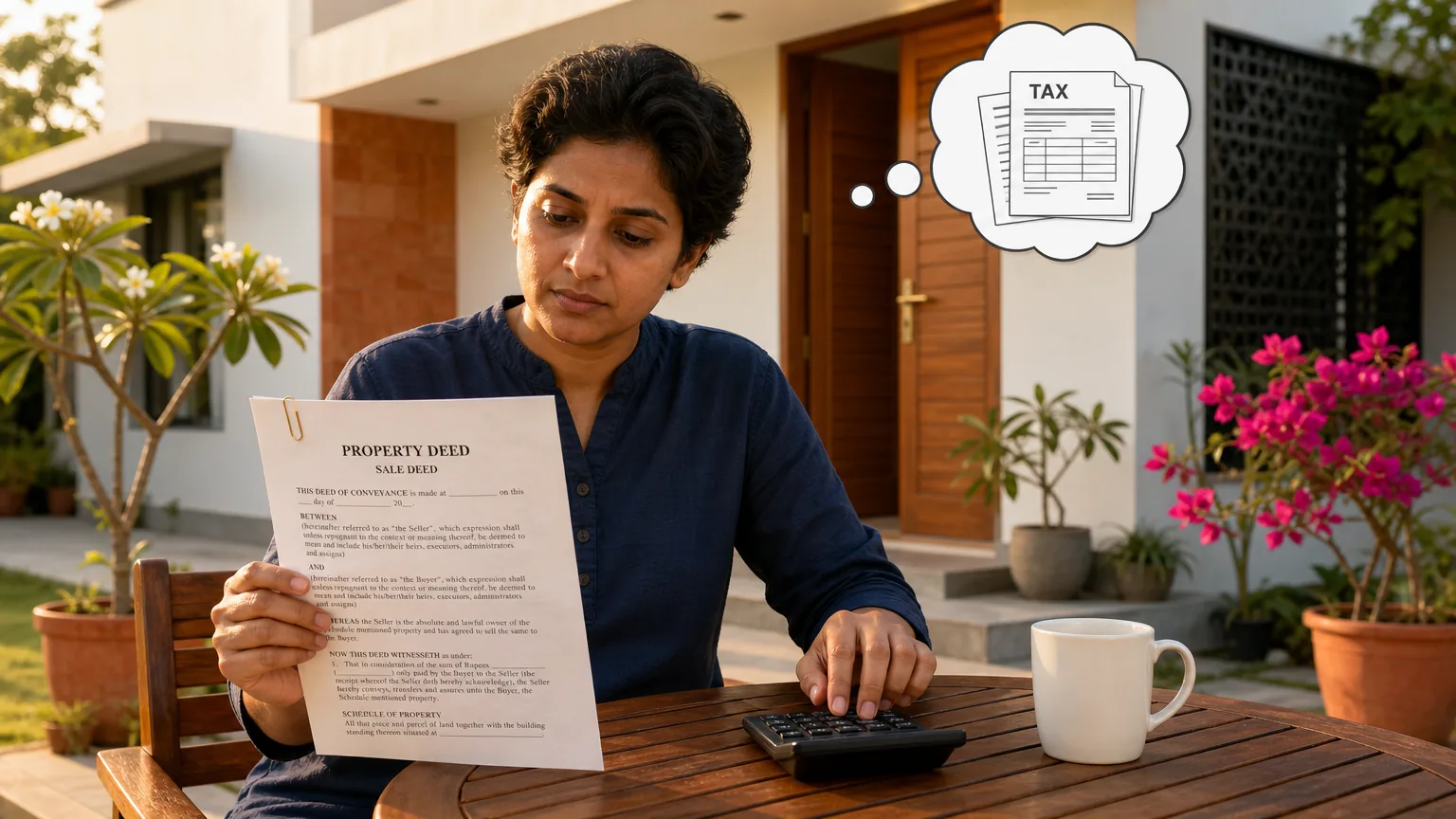
How Is Capital Gain on Inherited Property Calculated in India? A Step-by-Step Guide
Inheriting a property can be a significant life event, bringing both emotional weight and financial considerations. While the act of inheriting property itself is not taxed in India, the moment you decide to sell it, capital gains tax comes into play. I am Parish Rao, a government-approved and IBBI registered valuer (IBBI/RV/02/2019/10843, CAT-I/443/117/2000-01), with 35 years of experience in property valuation. I am here to help you understand this often complex process. This guide will walk you through the steps to calculate your capital gains tax, ensuring you comply with Indian tax laws.
- Inheritance itself is tax-free in India.
- Tax is only applicable when you sell the inherited property.
- The "Cost of Acquisition" and "Holding Period" are taken from the previous owner.
- A government-approved valuation is crucial for properties acquired before April 1, 2001.
Do I Pay Tax When I First Inherit a Property?

No, the act of inheriting a property, whether it is residential, commercial, or land, from a relative is not a taxable event in India. Under Section 49(1) of the Income Tax Act, 1961, inheritance is considered a "transfer" but is specifically exempt from capital gains tax. This rule applies whether you inherit through a will or under succession laws. No tax is payable by you at the time of inheritance. You can refer to the official text of the Income Tax Act, 1961, specifically Section 49, on the Income Tax Department's website for further details.
When Does Capital Gains Tax Apply to Inherited Property?
Capital gains tax is triggered only when you, the new owner, decide to sell the property. The profit or "gain" you make from selling the property is considered income and is taxed under the head "Capital Gains." This gain is categorized into two types based on how long the property was held:
- Short-Term Capital Gain (STCG)
- Long-Term Capital Gain (LTCG)
How Do I Determine the "Holding Period" for an Inherited Property?
This is a special provision for inherited assets. The holding period for an inherited property includes the time it was held by the previous owner(s). The date you acquired it is not what matters for calculating the holding period.
- Long-Term: If the property was held by you AND the previous owner for a combined total of more than 24 months.
- Short-Term: If the combined holding period is 24 months or less.
For example, if your father bought a house in 2010 and you inherited it in 2022 and sold it in 2023, the total holding period is 13 years (2010 to 2023). This makes it a Long-Term Capital Asset.
What Is the "Cost of Acquisition" for an Inherited Property?
The cost of acquisition for you is the original purchase price paid by the previous owner who first acquired the property, not through inheritance or gift. Since you, the inheritor, did not pay for the property, the law allows you to "step into the shoes" of the previous owner, as per Section 49(1) of the Income Tax Act.
Here is a crucial point: if the property was acquired by the previous owner before April 1, 2001, a special rule applies. In this case, the "Cost of Acquisition" is the higher of:
1. The original purchase price paid by the previous owner.
2. The Fair Market Value (FMV) of the property as on April 1, 2001.
To determine the FMV as on April 1, 2001, you need a valuation report from a government-approved and registered valuer. In India, these valuers are certified by regulatory bodies such as the Income Tax Department (under Section 34AB of the Wealth Tax Act, 1957, which is now relevant for Income Tax purposes) and the Insolvency and Bankruptcy Board of India (IBBI) under the Companies (Registered Valuers and Valuation) Rules, 2017. Rao Valuers holds both government approval and IBBI registration. This is not a guess; it is a legal requirement for accurate tax calculation.
> Work with Rao Valuers
>
> Get a free valuation quote →
How Do I Calculate Long-Term Capital Gain (LTCG)?
LTCG is calculated by subtracting the "Indexed Cost of Acquisition" and the "Indexed Cost of Improvement" from the sale price.
LTCG = Full Value of Consideration (Sale Price) - Indexed Cost of Acquisition - Indexed Cost of Improvement - Transfer Expenses.
What is Indexation? Indexation is a benefit that adjusts the purchase cost for inflation, effectively reducing your taxable gain. This is a significant advantage for long-term capital assets.
The formula for Indexed Cost of Acquisition is:
(Original Cost or FMV as on 1.4.2001) x (CII for the year of sale / CII for the year of purchase OR for FY 2001-02 if purchased before that).
You can find the official Cost Inflation Index (CII) table on the Income Tax Department's website.
Worked Example:
- Property bought by father in 1995 for ₹5 Lakhs.
- You inherited it in 2015.
- You sold it in 2023 for ₹90 Lakhs.
- Since it was bought before 2001, you need its FMV as on April 1, 2001. You get a valuation report from Rao Valuers, which states the FMV is ₹12 Lakhs.
- You will use ₹12 Lakhs (the higher of ₹5 Lakhs and ₹12 Lakhs) as your cost.
- CII for 2001-02 = 100. CII for 2023-24 = 348 (using the latest available index for illustration).
- Indexed Cost = ₹12,00,000 x (348 / 100) = ₹41,76,000.
- LTCG = ₹90,00,000 (Sale Price) - ₹41,76,000 (Indexed Cost) = ₹48,24,000.
- Tax on LTCG = 20% of ₹48,24,000.
Specific Example from Rao Valuers' Experience:
A client, Ms. Sharma, inherited a commercial plot in Delhi purchased by her grandfather in 1985 for ₹2 Lakhs. When she decided to sell it in 2022 for ₹1.5 Crore, the challenge was establishing the FMV as on April 1, 2001. Without a proper valuation, she would have had to use the original purchase price, leading to a much higher taxable gain. Rao Valuers conducted a detailed valuation, considering historical property rates, location, and development, and determined the FMV as on April 1, 2001, to be ₹25 Lakhs.
Using the CII for 2001-02 (100) and 2022-23 (331), the indexed cost was calculated as: ₹25,00,000 x (331 / 100) = ₹82,75,000.
Her LTCG was then ₹1,50,00,000 - ₹82,75,000 = ₹67,25,000.
If she had used the original cost without indexation, her gain would have been significantly higher. Our accurate valuation helped her save substantial tax.
Why Is a Professional Valuation Report Essential?
An official valuation report from a registered valuer is the only legally accepted proof of the Fair Market Value (FMV) of your property as on April 1, 2001. The Income Tax Department can scrutinize and reject self-assessed or unsubstantiated values. A certified report from a firm like Rao Valuers provides a defensible and accurate basis for your tax calculations, preventing future legal issues and penalties. It ensures you do not overpay tax by using a lower-than-actual FMV, or underpay and face penalties by using an inflated one. With 35 years of experience, our reports are accepted by the Income Tax Department.
Do you need to determine the Fair Market Value of your inherited property as on April 1, 2001? Contact Rao Valuers for a government-approved valuation report and ensure your tax calculations are accurate and compliant.
Can I Save Tax on These Capital Gains?
Yes, you can claim exemptions on Long-Term Capital Gains by reinvesting the proceeds in specified assets.
Here are some common exemptions under the Income Tax Act:
- Section 54: Reinvesting in another residential property.
- Section 54EC: Investing in specified capital gain bonds, for example, those from REC or NHAI.
- Section 54F: For assets other than a house, reinvesting the net consideration in a residential property.
This section is a brief overview. For detailed tax planning and investment advice, I always recommend consulting a Chartered Accountant (CA).
The information provided on this page is for educational purposes only and should not be considered as legal or financial advice. Please consult with a qualified Chartered Accountant for advice tailored to your specific situation.
Understanding the nuances of capital gains on inherited property is crucial for compliance and effective tax planning. A precise valuation, especially for properties acquired before April 1, 2001, is not merely a recommendation but a legal necessity. Rao Valuers, with our extensive experience and government approvals, provides reliable and accurate valuation reports that stand up to scrutiny by the Income Tax Department. Ensure your financial decisions are based on solid, verifiable data.
Contact Rao Valuers for a government-approved valuation report
Checked by Parish Rao, Chartered Engineer and Government Approved Valuer (Registration number CAT-I/443/117/2000-01).
Get a free valuation quote
Tell us what you need valued. We will message you on WhatsApp with which report you need and what it costs, free of charge.
In a hurry? Call +91 98681 69747 instead.