
How Land Market Value is Determined in India (2026)
Many people in India who own, buy, or inherit property feel confused about what their land is truly worth. You hear various terms like 'market value' and government rates like 'circle rate' or 'guideline value', and it is hard to know which one matters for your situation.
How Land Market Value is Determined in India
Many people in India who own, buy, or inherit property feel confused about what their land is truly worth. You hear various terms like 'market value' and government rates like 'circle rate' or 'guideline value', and it is hard to know which one matters for your situation. This guide will help you understand how your land's value is actually determined and when you need a professional valuation.
What Exactly is the Market Value of Land?
Market value is the estimated price a willing buyer would pay to a willing seller in an open market transaction, with neither person under any pressure to buy or sell. It reflects the real-world dynamics of supply and demand for that specific piece of land.
It is important to understand that market value is not a fixed government number. It is different from 'Guideline Value' or 'Circle Rate', which is the minimum value set by the government for calculating stamp duty and registration fees. Think of Guideline Value as the minimum price for a product, while Market Value is the actual price it sells for, which can be higher or lower depending on demand.
What Key Factors Influence My Land's Market Value?
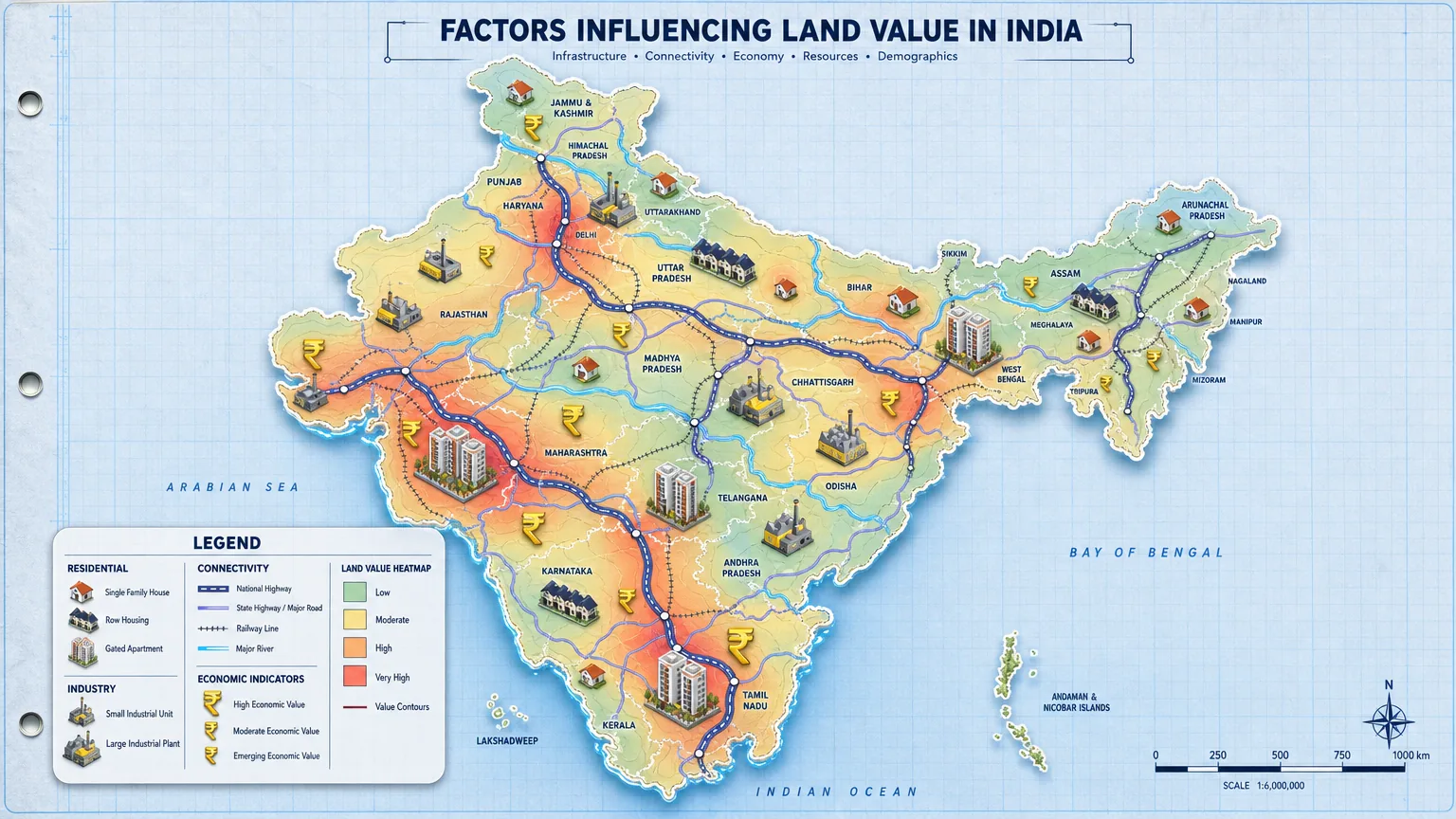
Your land's value is not just about its size. Location and potential are paramount. Many external factors, some beyond your control, determine the final value.
Here are the key factors we consider:
- Location and Accessibility: How close is your land to city centers, main roads, public transport, schools, hospitals, and markets? Proximity to essential services and good connectivity significantly increases value.
- Land Use and Zoning: Is your land zoned for residential, commercial, agricultural, or industrial use? The permitted use directly impacts its value. Converting agricultural land to residential, for example, can be a complex process but often increases value.
- Size and Shape: A regular, flat plot is generally more valuable and easier to develop than one that is sloped, irregular, or oddly shaped.
- Infrastructure: The availability of basic services like water, electricity, sewage lines, and internet connectivity makes a property more desirable and valuable.
- Future Development: Planned government projects, such as new highways, metro lines, or Special Economic Zones (SEZs) nearby, can dramatically increase your land's value even before they are completed.
- Legal Status: A clear title is crucial. Any liens, disputes, or encumbrances on the property can significantly reduce its market value or make it unsellable.
How Can I Get a Rough Estimate of My Land's Market Value?
You can arrive at a reasonable estimate of the market value yourself. These methods are for informational purposes only and are not a substitute for a formal valuation report.
- The Comparative Method: This is the most common approach. Look for recent sale prices of similar plots of land in your immediate vicinity. You can talk to local real estate brokers, check online property portals, and speak with neighbors. Try to find plots with similar characteristics, like size, location, and permitted use.
- The Development Method (Simplified): For plots with building potential, you can get a very basic idea by estimating the potential value of a developed property on your land. Then, subtract the estimated costs of construction, marketing, and a reasonable profit margin for a developer. This is a complex method for professionals, but a simplified thought experiment can give you a rough upper limit.
Why is the Government's Guideline Value or Circle Rate Not the True Market Value?
This is a common point of confusion for many property owners in India. The Guideline Value, also known as Circle Rate or Ready Reckoner Rate, is a minimum benchmark set by state governments. It exists primarily for legal and tax purposes, specifically to calculate stamp duty and registration fees during property transactions.
In most urban and developing areas, the Market Value of land is significantly higher than the Guideline Value. The government updates these rates periodically, but they often do not keep pace with the rapid appreciation of real estate in many parts of India. Relying solely on Guideline Value can lead to undervaluing your asset significantly, especially if you are calculating capital gains tax or applying for a loan. Stamp duty and registration fees are calculated based on the higher of the Guideline Value or the actual transaction value.
For more information on Guideline Values or Circle Rates, you can refer to official state government revenue department websites, such as the Department of Stamps and Registration, Government of Karnataka (@L1) or the Inspector General of Registration and Stamps, Government of Maharashtra (@L2).
When Do I Need a Professional and Certified Valuation Report?
While an informal estimate is fine for your personal knowledge, a certified valuation report from a government-approved valuer is mandatory for official and legal purposes. A government-approved valuer provides an unbiased, defensible report that institutions accept without question.
You will need a professional valuation report in scenarios like these:
- Applying for a home loan or loan against property: Banks require a valuation report to determine the loan-to-value (LTV) ratio.
- Capital gains tax calculation: To calculate your capital gains tax accurately, especially for properties bought before April 1, 2001, you need a Fair Market Value as of 2001. A valuation report helps you claim the correct indexation benefits.
- Visa applications: Some countries require proof of net worth, which includes property value, for visa or immigration purposes.
- Resolving family settlements, inheritance, or divorce proceedings: An impartial valuation helps ensure fair distribution of assets.
- Legal disputes: For court cases involving property, a certified valuation report holds legal weight.
- Company audits and financial reporting: For businesses holding land as an asset.
How Does a Government-Approved Valuer Determine the Market Value?
At Rao Valuers, our process is systematic and evidence-based, following established standards. We combine multiple methods to arrive at the most accurate and justifiable value for your land.
Here is how we determine market value:
- Site Visit and Physical Inspection: We physically inspect your land to verify its features, dimensions, and boundaries, while also assessing the surrounding area's development and infrastructure.
- Document Verification: We scrutinize crucial documents like the title deed, survey plans, property tax receipts, and zoning permissions to confirm legal ownership and permitted use.
- Market Research: We conduct in-depth research on recent comparable transactions of similar properties in your locality. We analyze local market trends, supply and demand, and any future development plans that could impact value.
- Valuation and Reporting: We synthesize all collected data and apply recognized valuation methodologies to arrive at the fair market value. This is then compiled into a comprehensive valuation report that clearly explains our methodology and the final value. Our reports go through banks, tax offices, and courts without coming back with questions.
Examples of Land Valuations by Rao Valuers
To illustrate how these factors come into play, consider these anonymized examples from our valuation experience:
- Agricultural Land, outskirts of Bengaluru: A 5 acre agricultural plot near Devanahalli, Bengaluru, was valued at INR 8.5 Crore. Key influencing factors included its proximity to the upcoming Bengaluru Satellite Town Ring Road and the potential for future conversion to residential use due to urban sprawl.
- Residential Plot, Mumbai Metropolitan Region: A 1,200 sq ft residential plot in Thane, Maharashtra, was valued at INR 2.2 Crore. This valuation was driven by its location within an established residential area with excellent public transport connectivity and clear title, making it highly desirable for immediate development.
- Commercial Land, Delhi NCR: A 2,500 sq ft commercial plot in Gurugram, Haryana, was valued at INR 6.8 Crore. Its high value was attributed to its strategic location on a major arterial road, existing commercial zoning, and strong demand for retail and office spaces in the area.
- Inherited Property, Rural Punjab: A 3 acre inherited agricultural land parcel in a village near Ludhiana, Punjab, was valued at INR 90 Lakh. The valuation considered its productive soil quality, access to irrigation, and prevailing agricultural land rates in the region, with limited immediate development potential.
These examples highlight how specific location, permitted use, and future prospects significantly impact the final market value, often differing greatly from the government's guideline value.
About the Author
The author is a knowledgeable and experienced property valuation expert, offering clear, direct advice and solutions.
Need an accurate and certified valuation for your land? Contact Rao Valuers for a consultation. Our government-approved experts operate across India to provide reports you can trust.
Get a free valuation quote: https://raovaluers.in/contact
Checked by Parish Rao, Chartered Engineer and Government Approved Valuer (Registration number CAT-I/443/117/2000-01).
Page last checked on 5 October 2026.
Get a free valuation quote
Tell us what you need valued. We will message you on WhatsApp with which report you need and what it costs, free of charge.
In a hurry? Call +91 98681 69747 instead.