
How to Price Your House for Sale: An Indian Valuation Guide
Determining the right selling price for your house involves combining a professional, government-approved valuation report with a thorough analysis of comparable sales in your locality and current market conditions.

Determining the right selling price for your house involves combining a professional, government-approved valuation report with a thorough analysis of comparable sales in your locality and current market conditions. This methodical approach ensures you achieve a fair market value, especially crucial for tax compliance and successful transactions in India.
By Parish Rao, Founder and Director of Rao Valuers
What "Right Selling Price" Actually Means
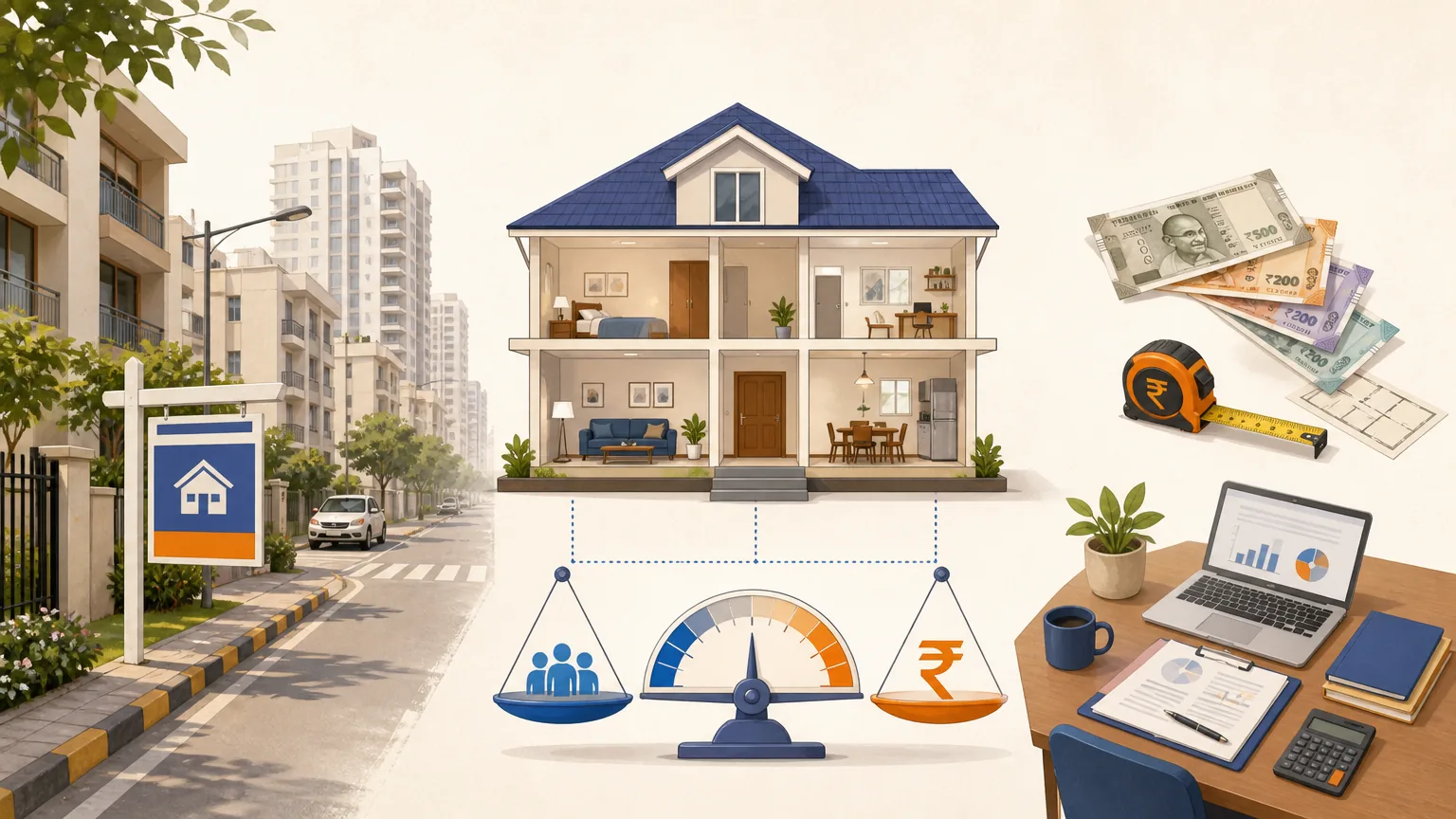
When we talk about the "right selling price" for your house, it is important to distinguish between a few related concepts. It is not just about the number you hope to get, or even the number a buyer offers.
- Fair Market Value (FMV): This is the most probable price a property would bring in a competitive and open market under all conditions requisite to a fair sale, with the buyer and seller each acting prudently, knowledgeably, and without undue pressure. This is the value a government-approved valuer determines.
- Asking Price: This is the price at which you, as the seller, choose to list your property. It is often influenced by the FMV, but also by your personal financial goals, urgency to sell, and negotiation strategy.
- Sale Price: This is the actual price agreed upon by the buyer and seller, and the price at which the property is eventually transacted. It can be higher or lower than the asking price, depending on negotiations and market dynamics.
The "right selling price" aims to align your asking price as closely as possible with the fair market value, ensuring you attract serious buyers while maximizing your return.
Step-by-Step Methods to Determine Your House's Selling Price
There are several approaches to valuing a property, each with its strengths and weaknesses. For a truly accurate and defensible selling price, especially in India, a combination of methods is usually best.
Get a Government-Approved/Professional Valuation Report
This is the most reliable and authoritative method. A government-approved valuer, registered with the Insolvency and Bankruptcy Board of India (IBBI), provides an impartial and expert assessment of your property's fair market value.
As government-approved and IBBI-registered valuers since 1995, we follow specific methodologies and adhere to valuation standards prescribed by regulatory bodies. Our reports consider various factors including location, property size, construction quality, age, amenities, and current market trends. This is particularly crucial for purposes like capital gains tax calculation, where an official valuation report is often required by the Income Tax Department. A report from a firm like Rao Valuers, with 35 years of experience and ISO 9001 certification, carries significant weight and is accepted by banks, tax authorities, and courts.
Comparable Sales (Comps) Analysis in Your Locality
This method involves looking at recent sales of similar properties in your immediate neighbourhood. "Similar" means properties with comparable size, age, condition, number of bedrooms, and amenities.
To conduct a good comps analysis:
- Focus on recent sales: Look at properties sold within the last 3-6 months. Older sales may not reflect current market conditions.
- Be specific to your area: Even properties a few streets away can have different values due to local amenities, school districts, or development plans.
- Adjust for differences: If a comparable property sold for ₹1.5 crore but had a renovated kitchen and yours does not, you would adjust its value downwards to estimate your property's value. Conversely, if your property has a unique feature like a larger plot or better view, you would adjust upwards.
- Sources: Real estate portals, local brokers, and government land records can provide data for comparable sales. However, these often lack the detailed property specifics that a professional valuer can access and interpret.
Online Valuation Tools and Calculators, What They Get Wrong
Many online portals offer "instant" property valuations. These tools typically use algorithms that pull data from public records and listing information.
While they can provide a very rough estimate quickly, they often fall short in India because:
- Limited data accuracy: Public records might not be updated or fully comprehensive regarding property features, improvements, or specific local nuances.
- Inability to assess condition: An algorithm cannot account for the wear and tear of your home, the quality of renovations, or unique architectural features that significantly impact value.
- Lack of local expertise: These tools cannot understand micro-market dynamics, upcoming infrastructure projects, or local demand shifts that a human valuer or local agent would know.
- Not legally accepted: Crucially, these estimates are not accepted by banks for loan purposes, by the Income Tax Department for capital gains, or by courts for legal matters. They serve as a starting point, not a definitive valuation.
Circle Rate / Guidance Value vs. Market Value in India
In India, the Circle Rate (also known as Guidance Value, Ready Reckoner Rate, or Collector Rate) is the minimum value at which a property can be registered during a sale or transfer. This rate is set by the state government and varies by locality.
- Market Value is the actual price a property can fetch in the open market, as determined by demand, supply, location, and property specifics.
- The difference: The market value is almost always higher than the circle rate, especially in prime locations. While stamp duty and registration charges are typically calculated based on the higher of the market value or circle rate, the circle rate is not your property's selling price. As government-approved valuers, we regularly see sellers confuse circle rate with market value. It is vital to understand that selling your property at merely the circle rate means you are likely underselling it significantly.
Adjusting for Property Condition, Age, and Improvements
Once you have a baseline valuation (preferably from a professional report and comps analysis), you need to adjust for your property's specific attributes.
- Condition: A well-maintained home with modern fixtures and fittings will command a higher price than a dilapidated one. Consider recent renovations, structural integrity, and aesthetic appeal.
- Age: Older properties may have lower values due to depreciation, but a well-maintained heritage property or one in a desirable, established area might hold its value or even appreciate.
- Improvements: Significant improvements like a new roof, upgraded plumbing, renovated bathrooms or kitchen, or added living space can increase value. Keep records of all major renovations, including costs, as these can be important for both valuation and capital gains calculations.
Reading Local Demand and Market Timing
The real estate market is dynamic. Your property's value is also influenced by broader economic factors and local demand.
- Demand: High demand for properties in your area, perhaps due to new businesses, improved infrastructure, or limited supply, can drive prices up. Low demand can lead to price stagnation or drops.
- Market Timing: Selling in a "seller's market" (high demand, low supply) typically yields better prices than a "buyer's market" (low demand, high supply). Seasonal variations can also play a role; for example, some areas see increased activity during specific seasons.
- Economic Indicators: General economic growth, interest rates, and employment levels can all influence housing market sentiment. The RBI housing price index reports and NHB RESIDEX can provide insights into general market trends across India.
Comparison Table: Ways to Determine Your Selling Price
Here is an honest look at different methods for determining a house's selling price:
| Method | Accuracy | Cost | Time Required | Legal/Bank Acceptance | Best Use Case |
|---|---|---|---|---|---|
| Government-Approved Registered Valuer Report | High (most precise and defensible) | Moderate to High | 48-72 hours typically | Yes (mandatory for many uses) | Capital Gains Tax, Bank Loans, Court Matters, Visa/Immigration, Inheritance, high-value transactions, dispute resolution |
| Local Real Estate Agent/Broker Estimate | Moderate to High (relies on local expertise) | Free (part of listing service) | Days to a week | No (not official) | Initial listing price guidance, general market understanding |
| Free Online Valuation Tools | Low (algorithmic, lacks nuance) | Free | Instant | No | Very rough initial estimate, curiosity |
| DIY Comparable Sales Research | Moderate (depends on data access and skill) | Free | Days to weeks | No | Informed negotiation, supplementing other methods |
| Circle Rate/Government Guidance Value Lookup | Very Low (minimum registration value) | Free | Instant | Yes (for stamp duty calculation only) | Determining minimum registration value, not market value |
It is important to understand that only a report from a government-approved registered valuer is legally accepted for critical financial and legal purposes, such as calculating capital gains tax or securing a bank loan.
Why the "Right" Price Differs by Purpose
The "right" price is not always a single, static number; it can depend on your specific objective for selling.
- Selling for Profit: If your primary goal is to maximize profit, you will aim for the highest possible market value, backed by a professional valuation and strong market analysis.
- Capital Gains Tax Filing: For calculating capital gains tax, especially if you have held the property for many years, you need a Fair Market Value (FMV) as of 1 April 2001. This requires a specific type of valuation report from an IBBI-registered valuer. The Income Tax Department's guidelines on Fair Market Value as of 1 April 2001 govern how these valuations are calculated, allowing you to benefit from indexation and potentially reduce your tax liability. For example, our capital gains valuation for property sale service is specifically designed for this.
- Distressed Sale: If you need to sell quickly due to financial pressure or relocation, you might price your property slightly below market value to attract immediate buyers. This is a strategic decision that prioritizes speed over maximizing profit.
- NRI Sale: Non-Resident Indian (NRI) sellers often have specific tax and repatriation considerations. While the valuation methodology remains the same, understanding the market value is crucial for compliance and optimizing the sale process. Our NRI property valuation services cater to these specific needs.
Common Mistakes Sellers Make When Pricing Their House
Sellers often make pricing errors that can lead to a prolonged sale process or leaving money on the table.
- Overpricing: This is the most common mistake. An overpriced property deters potential buyers, leads to longer listing times, and often results in eventual price reductions that make the property seem undesirable. Buyers are savvy and will compare your price to similar properties.
- Underpricing: While less common, underpricing means you are selling your valuable asset for less than its worth, resulting in a direct financial loss.
- Relying Solely on Online Estimates: As discussed, these tools lack the accuracy and depth needed for a serious sale.
- Ignoring Market Feedback: If your property is not getting viewings or offers, it is a strong signal that your price might be too high for the current market.
- Emotional Pricing: Attaching sentimental value to your home and pricing it based on personal feelings rather than objective market data. While understandable, emotions do not influence market value.
- Not Accounting for Capital Gains: Failing to get a proper valuation for tax purposes can lead to incorrect capital gains calculations and potential issues with the Income Tax Department later.
> Work with Rao Valuers
>
When You Legally Need a Registered Valuer's Report (Not Just an Estimate)
While an agent's estimate can help with listing, there are specific situations in India where a formal, government-approved valuation report from an IBBI-registered valuer is not just recommended, but legally required or highly advisable.
- Capital Gains Tax Calculation: If you are selling a property held for a long time, you need a valuation report to establish the Fair Market Value as of April 1, 2001, for indexation benefits. This significantly impacts your tax liability.
- Income Tax Schedule AL Valuation: For high net-worth individuals, the Income Tax Department may require a valuation of immovable property for Schedule AL filing.
- Bank/Loan Valuation: When applying for a home loan, mortgage, or loan against property, banks mandate a valuation report from their empaneled government-approved valuers to assess the property's collateral value. Our bank loan valuation report service assists with this.
- Court/Family Matters: In cases of property division during divorce, inheritance disputes, or other legal proceedings, courts often require an independent, expert valuation.
- Visa/Immigration Purposes: Some countries require proof of assets, including property valuation reports, for visa or immigration applications. Our reports are accepted by various embassies.
- Inherited Property Valuation: For estate planning, probate, or division among heirs, an official valuation helps ensure fairness and compliance.
In our experience preparing valuation reports since 1995, these scenarios consistently require the technical credibility and legal acceptance that only a registered valuer can provide.
FAQ
Is a bank valuation the same as the right selling price?
A bank valuation assesses the property's collateral value for a loan, which is often conservative. While it is based on market principles, it might not always reflect the highest possible selling price you could achieve in an open market, especially if the market is buoyant. It serves a different purpose, primarily risk assessment for the lender.
Do online property value calculators actually work in India?
Online calculators provide very rough estimates based on limited data. They do not account for your property's specific condition, unique features, or the micro-market dynamics that significantly influence value in India. They are not reliable for setting a selling price or for official purposes.
How is fair market value different from circle rate?
Fair Market Value (FMV) is the actual price a property can fetch in the open market. Circle rate is the minimum government-mandated price for property registration. FMV is almost always higher than the circle rate. You should aim to sell at FMV, not just the circle rate.
Do I need a registered valuer just to sell my house, or only for tax purposes?
You do not strictly need a registered valuer just to list your house for sale. However, you absolutely need one for specific purposes like calculating capital gains tax, obtaining a bank loan, or for legal matters. A professional valuation also gives you a strong, defensible basis for your asking price.
How long does a professional valuation take before I can list my house?
At Rao Valuers, we typically provide comprehensive valuation reports within 48 to 72 hours of inspection. This quick turnaround allows you to proceed with listing your house without significant delays.
Can I use a valuation report to negotiate with buyers?
Yes, a professional valuation report provides an objective, expert-backed assessment of your property's worth. It can be a powerful tool in negotiations, helping you justify your asking price and providing buyers with confidence in the value they are paying.
Conclusion
Determining the right selling price for your house in India is a critical step that impacts your financial outcome and the speed of your sale. While various methods exist, combining a professional, government-approved valuation with a thorough understanding of comparable sales and market conditions provides the most accurate and defensible pricing strategy.
For precise, legally compliant, and market-informed valuations, especially for capital gains, bank loans, or other official purposes, trust an experienced and accredited firm. Rao Valuers, with 35 years of experience as government-approved and IBBI-registered valuers, offers reliable reports accepted by all major institutions across India.
Ready to get an accurate valuation for your property? Request a free, no-obligation consultation via WhatsApp today. We aim to respond promptly to all inquiries.
Contact Rao Valuers for a free consultation
Checked by Parish Rao, Chartered Engineer and Government Approved Valuer.
Page last checked on 14 September 2026.
Get a free valuation quote
Tell us what you need valued. We will message you on WhatsApp with which report you need and what it costs, free of charge.
In a hurry? Call +91 98681 69747 instead.