
Immigration Property Valuation Report: Your 2026 Guide
An immigration property valuation report is a government-approved document certifying the current market value of your property, issued by an IBBI-registered and government-approved valuer.
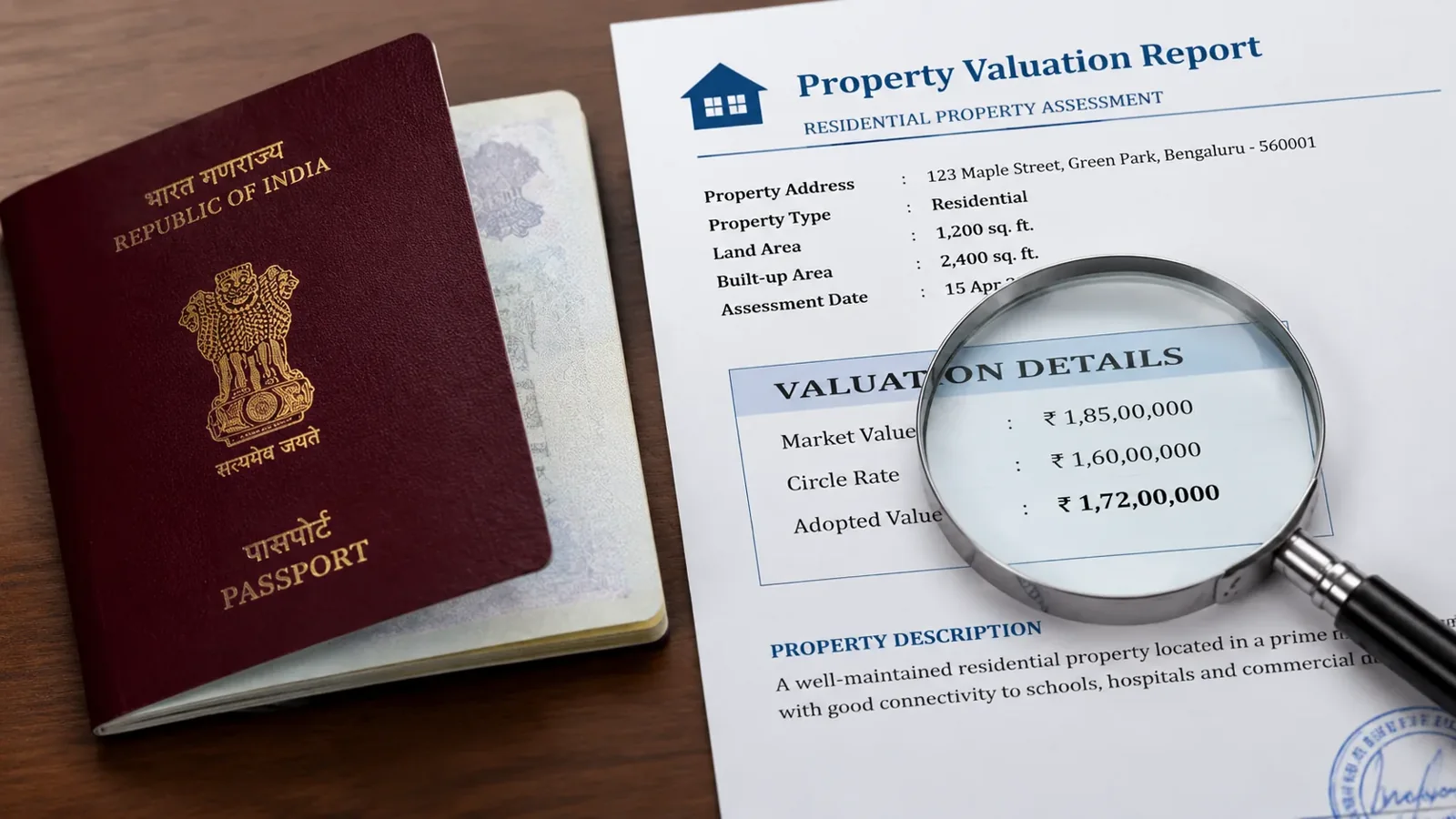
An immigration property valuation report is a government-approved document certifying the current market value of your property, issued by an IBBI-registered and government-approved valuer. This report is often required by embassies or immigration authorities as proof of assets, net worth, or settlement funds for various visa categories, ensuring you meet the financial criteria for your application.
What Is an Immigration Property Valuation Report?
An immigration property valuation report, specifically tailored for visa and residency applications, provides an official, independent assessment of a property's market value. This is not a casual estimate. It is a formal document prepared by a qualified valuer, adhering to strict professional standards and legal requirements in India.
The report serves as concrete evidence of your financial standing. Embassies and immigration authorities need to verify that applicants have sufficient resources to support themselves and their families in the destination country, or to meet specific investment criteria. A property valuation report translates your real estate holdings into a quantifiable asset, recognized by international bodies.
Why embassies and immigration authorities ask for it
Embassies and immigration authorities require these reports for several key reasons:
- Proof of Funds: Many visa categories, especially those for skilled migration or permanent residency, demand applicants demonstrate a certain level of financial stability to prevent them from becoming a public charge. Your property's value contributes to this proof.
- Net Worth Declaration: Investor or business visas often have minimum net worth requirements. A detailed property valuation report helps applicants accurately declare their assets.
- Sponsorship Affidavits: For family sponsorship visas, the sponsor might need to prove they have the financial capacity, including property assets, to support the incoming family member.
- Settlement Funds: Some countries require proof of settlement funds, indicating you have enough money to establish yourself upon arrival. Property, when valued correctly, can be a significant part of these funds.
Since 1995, Rao Valuers has prepared numerous reports for individuals migrating to various countries, understanding the specific requirements of different consulates and high commissions. Our ISO 9001 certification ensures our processes meet international quality standards, which is crucial for reports intended for overseas submission.
Which Countries/Visa Categories Typically Require This Report
While specific requirements vary by country and visa type, several common scenarios necessitate an immigration property valuation report.
Examples, skilled migration, investor/business visas, family sponsorship
- Skilled Migration Visas: Countries like Canada, Australia, the UK, and New Zealand often require proof of funds. While cash in bank accounts is primary, significant property assets can bolster an application, especially if liquid assets are borderline.
- Investor/Business Visas: Programs in the USA (EB-5), Canada, Australia, and various European countries (Golden Visas) frequently demand applicants demonstrate a substantial net worth, a significant portion of which might be tied up in real estate. The valuation report provides the official figure for these assets.
- Family Sponsorship Visas: When sponsoring parents, spouses, or dependent children, the sponsor in the destination country may need to show they have the financial means to support them. Property ownership in India, properly valued, can contribute to this financial proof.
- Student Visas: In some cases, for student visas, particularly if the applicant is relying on parental support, property assets can be used to demonstrate the family's financial capacity to fund education and living expenses abroad.
It is important to note that while the property valuation report confirms the asset's value, it does not guarantee its liquidity. Immigration authorities are primarily interested in the verifiable existence and worth of the asset.
What Must Be Included in a Valid Immigration Valuation Report
For an immigration property valuation report to be accepted, it must meet specific criteria. This is where the expertise of a government-approved valuer becomes critical.
Registered/government-approved valuer signature and credentials
The most important aspect is the credential of the valuer. The report must be signed by an individual who is:
- Government-Approved: In India, this means the valuer is registered under the Wealth Tax Act, 1957, or subsequent relevant legislation.
- IBBI-Registered: For property valuations, an individual registered with the Insolvency and Bankruptcy Board of India (IBBI) as a Registered Valuer under the Companies (Registered Valuers and Valuation) Rules, 2017, holds the highest professional standing. This registration ensures adherence to stringent ethical and professional standards.
The report must clearly state the valuer's registration numbers, qualifications, and professional body memberships. Without these, the report will likely be rejected.
Current market value vs. distress/forced sale value
The valuation must reflect the current market value of the property. This is the estimated amount for which a property should exchange on the date of valuation between a willing buyer and a willing seller in an arm's length transaction after proper marketing, where the parties had acted knowledgeably, prudently, and without compulsion.
It is distinctly different from a "distress sale" or "forced sale" value, which would be lower due to immediate selling pressure. Immigration authorities are interested in the true, fair market value of your assets under normal market conditions.
Property documents required (title deed, tax receipts, site plan)
To prepare an accurate and defensible report, the valuer will require a specific set of documents. These typically include:
- Title Deed/Sale Deed: Proof of ownership.
- Property Tax Receipts: Recent receipts demonstrating regular payment of property taxes.
- Sanctioned Building Plan/Site Plan: To verify the legal construction and layout of the property.
- Occupancy Certificate/Completion Certificate: If applicable, for newly constructed properties.
- Khata Certificate/Extract: For properties in Karnataka, for instance, to confirm property details.
- Encumbrance Certificate: To ensure the property is free from legal disputes or mortgages.
- Identity Proof of Owner(s).

Immigration Valuation vs. Other Valuation Report Types
Understanding the differences between various types of property valuation reports is crucial. While the core process of assessing property value has similarities, the purpose, legal framework, and specific reporting requirements vary significantly.
| Report Type | Purpose | Typical Requester | Turnaround |
|---|---|---|---|
| Immigration/Visa Valuation | Proof of assets/net worth for visa/residency applications | Embassies, Immigration Authorities | 48-72 hours (Rao Valuers) |
| Bank Loan/Mortgage Valuation | Determine collateral value for lending | Banks, Financial Institutions | Varies, often 7-10 business days |
| Capital Gains (Income Tax) Valuation | Ascertain Fair Market Value for tax computation (e.g., Section 50C) | Income Tax Department, Property Owners | 48-72 hours (Rao Valuers) |
| Court/Legal Valuation | For litigation, divorce, inheritance, dispute resolution | Courts, Lawyers, Legal Entities | Varies, can be extensive |
| Approved Valuers Directories | Listings of registered valuers by professional bodies | Individuals seeking valuers, Professional Bodies | N/A (directory, not a report) |
| Institution of Valuers (IOV) | Professional body setting standards for valuers | Valuers, Regulatory Bodies | N/A (standards, not a report) |
This table highlights that while "Approved Valuers" directories or the "Institution of Valuers (IOV)" are essential resources for finding qualified professionals and defining standards, they do not themselves issue valuation reports. They are authoritative bodies or listings that help you identify a firm like Rao Valuers, which then provides the specific report you need.
Who Is Authorized to Issue an Immigration Valuation Report
The authorization to issue a property valuation report for immigration purposes is a critical point. Not just any valuer's report will be accepted.
Difference between IBBI-registered valuers, government-approved valuers, and general "valuation consultants"
- IBBI-Registered Valuers: These are professionals registered with the Insolvency and Bankruptcy Board of India (IBBI) under the Companies (Registered Valuers and Valuation) Rules, 2017. They undergo rigorous training, examinations, and adhere to a strict code of conduct. This is the highest standard of professional recognition for valuers in India, making their reports highly credible and widely accepted, including for international purposes. Rao Valuers is IBBI-registered.
- Government-Approved Valuers: Historically, these valuers were approved by the Central Board of Direct Taxes (CBDT) under the Wealth Tax Act, 1957. While the Wealth Tax Act has been repealed, the term "government-approved" still signifies a valuer who has met stringent government criteria and is authorized to provide valuations for official purposes, including income tax and other government departments. Many IBBI-registered valuers also carry this historical "government-approved" status.
- General "Valuation Consultants": This is a broad term that can include individuals or firms offering valuation services without specific government or IBBI registration. While they might be competent for informal assessments or internal company use, their reports are generally not accepted by embassies, banks, or tax authorities for official purposes. Always verify the valuer's credentials.
For immigration purposes, you absolutely need a report from an IBBI-registered and/or government-approved valuer. Our 35 years of experience, coupled with our IBBI registration and government approval, means our reports carry the necessary authority and acceptance.
> Work with Rao Valuers
>
Step-by-Step: How to Get an Immigration Valuation Report
Getting your property valuation report for immigration does not have to be a complex process, especially with an experienced firm.
Documents to prepare
Before you even contact a valuer, gather these essential documents:
1. Title Deed/Sale Deed: The primary document proving ownership.
2. Property Tax Receipts: Latest receipts.
3. Approved Building Plan/Site Plan: Essential for verifying property dimensions and legal construction.
4. Occupancy/Completion Certificate: If available, for constructed properties.
5. Encumbrance Certificate: To confirm no outstanding liabilities on the property.
6. Any Lease Agreements: If the property is rented out.
7. Owner's ID and Address Proof.
Having these ready will significantly speed up the process.
Typical timeline (use Rao Valuers' actual 48-72 hour figure)
Once you provide all necessary documents and property access for inspection, the process with Rao Valuers is streamlined:
1. Initial Consultation: Contact us via WhatsApp for a free, no-obligation consultation. We will discuss your specific needs and the documents required.
2. Document Submission: You submit the required documents, often digitally.
3. Property Inspection: Our qualified valuer conducts a physical inspection of the property. This is mandatory to verify details and assess current market conditions.
4. Report Preparation: Based on the inspection and documents, our team prepares the detailed valuation report.
5. Report Delivery: We deliver the final, signed, and stamped report typically within 48-72 hours of the inspection and receipt of all documents. This quick turnaround is often critical for visa deadlines.
We understand the urgency often associated with immigration applications. Our efficient process is designed to meet these tight deadlines without compromising on accuracy or compliance.
Common Mistakes That Get Immigration Valuation Reports Rejected
Even with a qualified valuer, certain errors can lead to delays or outright rejection of your report by immigration authorities.
- Using an Unqualified Valuer: The most frequent mistake. Reports from non-government-approved or non-IBBI-registered valuers are almost always rejected.
- Incomplete Documentation: Failing to provide all necessary property documents to the valuer can lead to an incomplete or inaccurate report.
- Outdated Valuation Date: Immigration authorities usually require a valuation report to be recent, often within 3-6 months of the application submission. An old report will be deemed invalid.
- Lack of Physical Inspection: A valuation done without a physical inspection of the property raises red flags. The report must confirm a site visit.
- Discrepancies in Information: Any mismatch between the report details and other submitted documents (e.g., owner's name, property address, area) can cause rejection.
- Incorrect Valuation Methodology: The report must clearly state the methodology used (e.g., market approach) and justify the valuation figure.
- Missing Valuer Credentials: The report must prominently display the valuer's registration number, signature, and stamp.
To avoid these pitfalls, choose an experienced and reputable firm like Rao Valuers, which has a proven track record of preparing reports accepted by various international bodies.
FAQ
Q: Do immigration authorities accept any property valuer's report, or does it need to be government-approved?
A: No, immigration authorities typically require reports from government-approved and/or IBBI-registered valuers. These credentials ensure the report's credibility, adherence to professional standards, and legal validity, which is crucial for official submissions.
Q: How long does an immigration property valuation report take?
A: With Rao Valuers, once all necessary documents are provided and the property inspection is completed, the final report is typically delivered within 48-72 hours. We prioritize efficiency for urgent visa deadlines.
Q: Is the valuation based on market value or purchase price?
A: The valuation for immigration purposes is based on the current market value of the property. This is the price it would fetch in an open market today, not its original purchase price, which can be significantly different.
Q: Can NRIs get an immigration valuation report for property in India remotely?
A: Yes, NRIs can absolutely get an immigration valuation report for their property in India remotely. Rao Valuers offers WhatsApp consultations and can coordinate with local contacts for property inspection, then deliver the report digitally or via courier. NRI Property Valuation Services are a core part of our offerings.
Q: Does the report need to be notarized or apostilled for embassy submission?
A: While the valuation report itself is issued by a government-approved authority, some embassies or consulates might require additional notarization or apostille for documents originating from India to be accepted in another country. It is best to check the specific requirements of the embassy or immigration authority you are dealing with.
Q: What if my property is jointly owned?
A: If the property is jointly owned, the valuation report will reflect this. All owners' names will be included, and their respective shares in the property will be noted. Ensure all joint owners are aware of and agree to the valuation request.
Q: Can I use a valuation report prepared for a bank loan for immigration purposes?
A: While both reports assess property value, a bank loan valuation might have different specific reporting formats or disclosures tailored for lending institutions. It is generally advisable to obtain a fresh report specifically for immigration, ensuring it meets all the particular requirements of the immigration authority.
Q: What if my property is under construction?
A: Valuing property under construction is more complex. A valuer can provide a valuation based on the current stage of construction and an estimated completion value. However, some immigration authorities might prefer fully completed properties as proof of assets.
Q: How does Rao Valuers ensure the report is accepted internationally?
A: Our reports are prepared by IBBI-registered and government-approved valuers, adhering to international valuation standards where applicable. Our 35 years of experience and ISO 9001 certification mean our reports are robust and recognized, having been accepted by various embassies and international bodies for years.
To get your government-approved property valuation report for immigration purposes quickly and reliably, reach out to us. We offer free consultations and our team is ready to assist you.
Contact Rao Valuers for a Free Valuation Quote via WhatsApp
Checked by Parish Rao, Chartered Engineer and Government Approved Valuer.
Page last checked on 9 September 2026.
Get a free valuation quote
Tell us what you need valued. We will message you on WhatsApp with which report you need and what it costs, free of charge.
In a hurry? Call +91 98681 69747 instead.