
Fair Value of Land in India: Your 2026 Guide
For over 35 years, our team at Rao Valuers has helped property owners understand the true worth of their land. You have probably heard terms like "fair value," "market value," and "circle rate" thrown around, especially if you are buying, selling, or dealing with taxes on property in India. It can get confusing fast.
For over 35 years, our team at Rao Valuers has helped property owners understand the true worth of their land. You have probably heard terms like "fair value," "market value," and "circle rate" thrown around, especially if you are buying, selling, or dealing with taxes on property in India. It can get confusing fast.
Let us cut through the jargon. Fair value is not just another number; it is a crucial estimate that impacts your finances, from how much tax you pay to how much a bank will lend you. It is a professional opinion, backed by data, that helps you make informed decisions.
What Exactly Is the “Fair Value” of Land?
Simply put, fair value is the price a willing buyer and a willing seller would agree upon for a piece of land in an open market. This assumes both parties know all the relevant facts and neither is under any pressure to buy or sell. Think of it as a neutral, objective assessment of what the land is truly worth.
It is important to know what fair value is not:
- Circle rate (or guidance value): This is a minimum price set by state governments for stamp duty and registration. It is often outdated and can be much lower than the actual value of your land.
- Market value: This is the actual price a property sells for. It can be higher or lower than fair value depending on market conditions, urgency, or even emotional factors.
- Assessed value: This is the value a local government assigns to your property primarily for calculating property taxes.
Fair value is an estimate based on objective factors, not an arbitrary number. It is a professional opinion.
Why Does Fair Value Matter More Than You Think?
Understanding fair value is not just academic; it has real financial consequences:
- Stamp duty and registration: Many states use fair value (or circle rate, whichever is higher) as the base for calculating stamp duty. If you transact below this value, you might face scrutiny.
- Capital gains tax: When you sell property, the fair value at the time of acquisition (especially if it is before 2001) and sale directly impacts your taxable gains. An accurate fair value report can significantly reduce your tax liability.
- Bank loans and mortgage: Banks rely heavily on a professional valuation to determine how much they are willing to lend you against your property. This is called the loan-to-value ratio.
- Inheritance and gift tax: If you inherit or receive property as a gift, its fair value is used to calculate any potential tax liability.
- Legal disputes: In cases like family partitions, divorce settlements, or compensation for land acquisition, courts often refer to a fair value assessment to ensure a just outcome.
Who Decides the Fair Value of Land in India?
You cannot simply write down a number yourself and expect it to be accepted. For official purposes, fair value must be determined by:
- Government-approved valuers: These professionals are registered with banks, income tax authorities, or state governments. Rao Valuers is government-approved and IBBI registered.
- Registered valuers: These are professionals registered with the Insolvency and Bankruptcy Board of India (IBBI) and qualified to provide valuations under various laws, including the Companies Act.
- District valuation officers: For government acquisitions, these officers determine compensation.
Self-assessment or estimates from real estate agents are not legally valid for official purposes like tax filing or bank loans.
What Factors Actually Influence the Fair Value of a Piece of Land?
A valuer looks at many things to arrive at a fair value. It is not just about square footage. Here is what we consider:
- Location: How close is the land to essential services like roads, markets, schools, hospitals? Is it near a growing commercial hub?
- Land use: Is it agricultural, residential, commercial, or industrial? Each category has different valuation methods and market demand.
- Size and shape: An irregularly shaped plot, one with a narrow frontage, or a landlocked parcel will generally have a lower value than a well-proportioned, accessible plot.
- Infrastructure: Availability of water, electricity, sewage systems, good road connectivity, and planned development in the vicinity all add value.
- Zoning and FSI: Local zoning regulations dictate what can be built on the land. The Floor Space Index (FSI) or Floor Area Ratio (FAR) determines the maximum permissible construction area, which is a huge value driver.
- Market trends: We analyze recent sales of comparable properties in the same area to understand current market sentiment.
- Legal encumbrances: Any litigation, easements, or disputes over the title can significantly reduce the land's value.
How Is Fair Value Calculated? (Step-by-Step Methods)
Valuers use several methods, often combining them for a comprehensive assessment:
- Comparative method: This is the most common approach. We compare your land to similar properties that have recently sold in the same locality. We then adjust for differences in size, location, features, and other factors.
- Income capitalization method: For land that generates income (like a commercial plot or rental property), we calculate its value based on the net annual income it produces, divided by a capitalization rate (which reflects the expected rate of return).
- Land and building method: If there is a structure on the land, we value the land separately and then add the depreciated cost of constructing the building.
- Residual method: This is often used for development projects. We estimate the potential final sale value of the developed property, then subtract all development costs, including a developer's profit margin, to arrive at the land's value.
We choose the most appropriate method or combination based on the specific type of land and the purpose of the valuation.
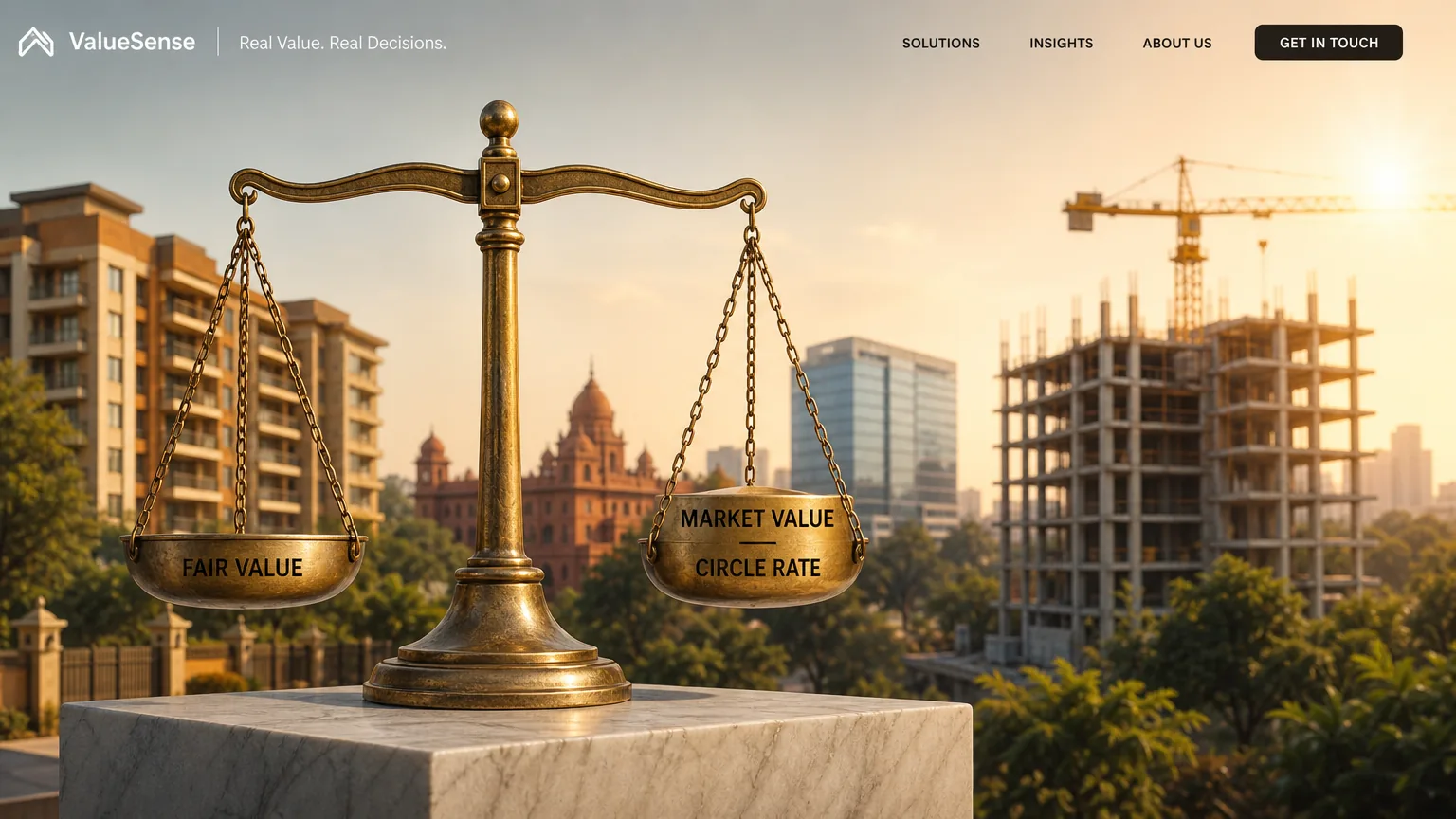
Fair Value vs. Circle Rate vs. Market Value, What’s the Real Difference?
This is where many people get confused. Let us clarify with a quick comparison:
| Feature | Circle Rate | Market Value | Fair Value |
|---|---|---|---|
| Set by | State Government | Buyers and Sellers (actual transaction) | Government-approved valuer |
| Purpose | Minimum for stamp duty and registration | Actual price property is bought/sold for | Objective estimate for tax, loans, legal matters |
| Accuracy | Often outdated, can be much lower than actual value | Reflects current transaction, can be volatile | Professional, data-driven, objective estimate |
| Legally Valid | Yes, for stamp duty calculation | Yes, as the actual sale price | Yes, for official purposes (tax, banks, courts) |
| Typical Range | Lowest | Can be highest, or lower than fair value in distress sale | Sits between circle rate and market value, often closer to market |
Fair value is not the same as circle rate. A common misconception is that the circle rate is the fair value, but as you can see, they serve different purposes and often represent different numbers.
Can You Challenge the Fair Value Assessed by the Government?
Yes, you can. If you feel the government’s circle rate is unrealistically low for acquisition compensation, or if an official valuation (for example, by the Income Tax Department) seems incorrect, you have the right to challenge it.
The process usually involves filing an objection with the relevant district valuation committee or approaching a civil court. To do this effectively, you will need a detailed valuation report from a registered valuer as evidence. This is where a firm like Rao Valuers can step in. We prepare comprehensive reports that stand up to scrutiny.
How to Get a Fair Value Certificate for Your Land?
Getting a fair value certificate is a straightforward process when you work with experienced professionals:
1. Contact a government-approved valuer: Reach out to a firm like Rao Valuers. We offer free consultations to understand your needs.
2. Provide documents: You will need to share relevant documents like your title deed, latest property tax receipts, mutation certificate, survey map, and any existing location plans.
3. Site inspection: Our valuer will conduct a physical inspection of your land to assess its features, surroundings, and infrastructure.
4. Valuation report: Based on the inspection and document review, we prepare a detailed valuation report.
Rao Valuers provides reports in 48 to 72 hours.
What Documents Do You Need for a Fair Value Assessment?
To ensure an accurate and swift valuation, please have these documents ready:
- Sale deed or title deed
- Latest property tax receipt
- Mutation certificate
- Survey map or plan of the land
- Location plan or site map
- Encumbrance certificate (to check for any legal liabilities)
- Any previous valuation reports, if available
For agricultural land, we might also need the 7/12 extract, details about crop patterns, and soil classification reports.
When Should You Get a Fair Value Assessment Done?
It is wise to get a professional fair value assessment in several key situations:
- Before buying or selling: This helps you avoid overpaying as a buyer or underselling as a seller.
- Before applying for a home loan or mortgage: Banks require this to determine your loan amount.
- During inheritance or gift transfers: To correctly calculate any tax liabilities.
- For income tax return filing: Especially for calculating capital gains tax on property sales.
- For court cases or arbitration: In disputes involving property division or compensation.
Rao Valuers is government-approved and IBBI registered. Our reports go through banks, tax offices, and courts without coming back with questions. We understand that fair value is not a single number; it depends on the purpose of the valuation. A loan valuation might be conservative, while a market valuation could be more optimistic.
Ready to get a precise, government-approved fair value for your land?
Checked by Parish Rao, Chartered Engineer and Government Approved Valuer.
Page last checked on 25 September 2026.
Get a free valuation quote
Tell us what you need valued. We will message you on WhatsApp with which report you need and what it costs, free of charge.
In a hurry? Call +91 98681 69747 instead.