
My Home Value on Zillow: India's Reality in 2026
By [Your Name], IBBI Registered Valuer, RICS Accredited Valuer, and Founder of Rao Valuers. With over two decades of experience in Indian property valuation, I've seen firsthand how crucial accurate, compliant valuations are for homeowners and investors across the country.
By [Your Name], IBBI Registered Valuer, RICS Accredited Valuer, and Founder of Rao Valuers. With over two decades of experience in Indian property valuation, I've seen firsthand how crucial accurate, compliant valuations are for homeowners and investors across the country. My firm, Rao Valuers, established in 1990, has completed over 50,000 valuations for banks, NBFCs, and individuals, ensuring financial and legal compliance.
You've probably stumbled upon Zillow's "Zestimate" if you've ever looked up property values online. It's a handy tool in the US, but what happens when you try to use it for your home in India? Let's clear up the confusion and show you how to get a valuation that actually matters here.
What does Zillow's "my home value" actually show?
Zillow's "Zestimate" is an automated valuation model (AVM). It crunches public data, tax records, and recent sales to give an estimated home value. The catch? It's only for US properties. Seriously, it doesn't cover Indian addresses, property types, or our unique market dynamics.
So, if you're trying to get a Zillow value for your Indian home, you won't find one. The tool simply isn't built for India. It can't account for local factors like floor area ratio (FAR), construction quality, or the complexities of legal titles here. For your Indian property, Zillow's value is irrelevant.
How accurate is Zillow's Zestimate for Indian properties?
Let's be blunt: Zillow's Zestimate has zero accuracy for Indian properties. Why? Because it has zero data for India. Zillow's own median error rate in the US is typically 2-7%, which is okay for a rough estimate there. But for India, the model has no training data, no local comparables, nothing.
Using Zillow for an Indian home is like trying to use a US weather forecast for Mumbai. The algorithm just doesn't have the information it needs. Indian property valuation depends on very specific things: government circle rates, location-specific demand, building age, and most importantly, a physical inspection. Zillow captures none of this.
Why should you trust a government-approved valuer like Rao Valuers?
When you need a home value that holds up in India, you need a government-approved valuer. Rao Valuers, established in 1990, has been providing valuation services for over 35 years. We are registered with the Indian government and approved by major banks, NBFCs (Non-Banking Financial Companies), and legal authorities.
Government-approved valuers follow strict guidelines, like the Valuation Standards issued by the Insolvency and Bankruptcy Board of India (IBBI) or the Royal Institution of Chartered Surveyors (RICS). This ensures you get an unbiased, legally valid report. For example, IBBI Valuation Standards 2018, Section 3, outlines the fundamental principles governing valuation practice in India. Similarly, RICS Valuation Global Standards (Red Book Global Standards) provide a global framework for consistent and ethical valuation. A professional valuation is often required for home loans, property disputes, inheritance, and critically, tax compliance (especially for capital gains). Zillow's estimate has no legal standing here.
Here are a few examples of properties Rao Valuers has recently valued:
- Residential Apartment, Bandra, Mumbai: A 3BHK apartment in a prime residential complex. Valuation was required for a home loan refinance. Our valuation report, based on comparable sales and a detailed inspection of the property's premium finishes and amenities, resulted in a loan approval of ₹5 Crore for the client.
- Commercial Office Space, Cyber City, Gurugram: A 5,000 sq ft commercial office space. The client needed a valuation for capital gains tax calculation after selling the property. Our assessment considered the high demand in the area, infrastructure, and rental yields, ensuring the client complied with tax regulations and avoided potential penalties.
- Agricultural Land, outskirts of Bengaluru: A 10-acre parcel of agricultural land. The valuation was for inheritance purposes and division among family members. We assessed the land's fertility, access to water, and proximity to developing areas, providing a fair and legally sound distribution basis.

How does Rao Valuers determine your home's value?
Our process is thorough and transparent. Here's how we do it:
1. Physical inspection: We visit your property to check its structure, amenities, and overall condition.
2. Market analysis: We analyze recent comparable sales in your specific locality.
3. Cost approach: We apply the cost approach, which means we calculate the land value plus the construction cost, then subtract depreciation.
4. Cross-checking: We cross-check our findings with government circle rates and current market trends.
5. Detailed report: Finally, we issue a comprehensive valuation report with all the supporting evidence.
This method gives you a value that banks accept for loans and that courts recognize in disputes. It's what you need for calculating your capital gains tax accurately, avoiding any issues with the income tax department.
What is the difference between Zillow's estimate and a professional valuation?
It's night and day. Here's a quick comparison:
| Feature | Zillow Estimate | Rao Valuers Professional Valuation |
|---|---|---|
| Method | Automated algorithm | Manual, expert assessment |
| Geographic Scope | US-only | Pan-India |
| Physical Inspection | No | Yes, mandatory |
| Legal Validity (India) | None | Yes, government-approved, bank-accepted |
| Basis | Public US data, tax records | On-site inspection, local market, circle rates |
| Purpose | General interest (US) | Loans, tax, legal, sale, inheritance (India) |
The difference is simple: one is an online guess for a different country, the other is an expert opinion backed by Indian regulations and accepted by all relevant authorities. This expert opinion protects you from over or under valuation, which can cost you a lot in taxes, loan amounts, or sale negotiations.
How to get your home valued by Rao Valuers (step-by-step)?
Getting a valuation from us is straightforward:
1. Request a valuation: Visit our website and fill out the "Request a Valuation" form, or simply call us.
2. Provide details: Tell us your property address, type, and the purpose of the valuation (e.g., sale, loan, capital gains tax).
3. Schedule inspection: We'll schedule a physical inspection of your property, usually within 48 hours.
4. Receive report: You'll get a digital valuation report within 2-3 working days after the inspection.
The process is transparent, fast, and fully compliant with Indian valuation norms. Our reports go through banks, tax offices, and courts without coming back with questions.
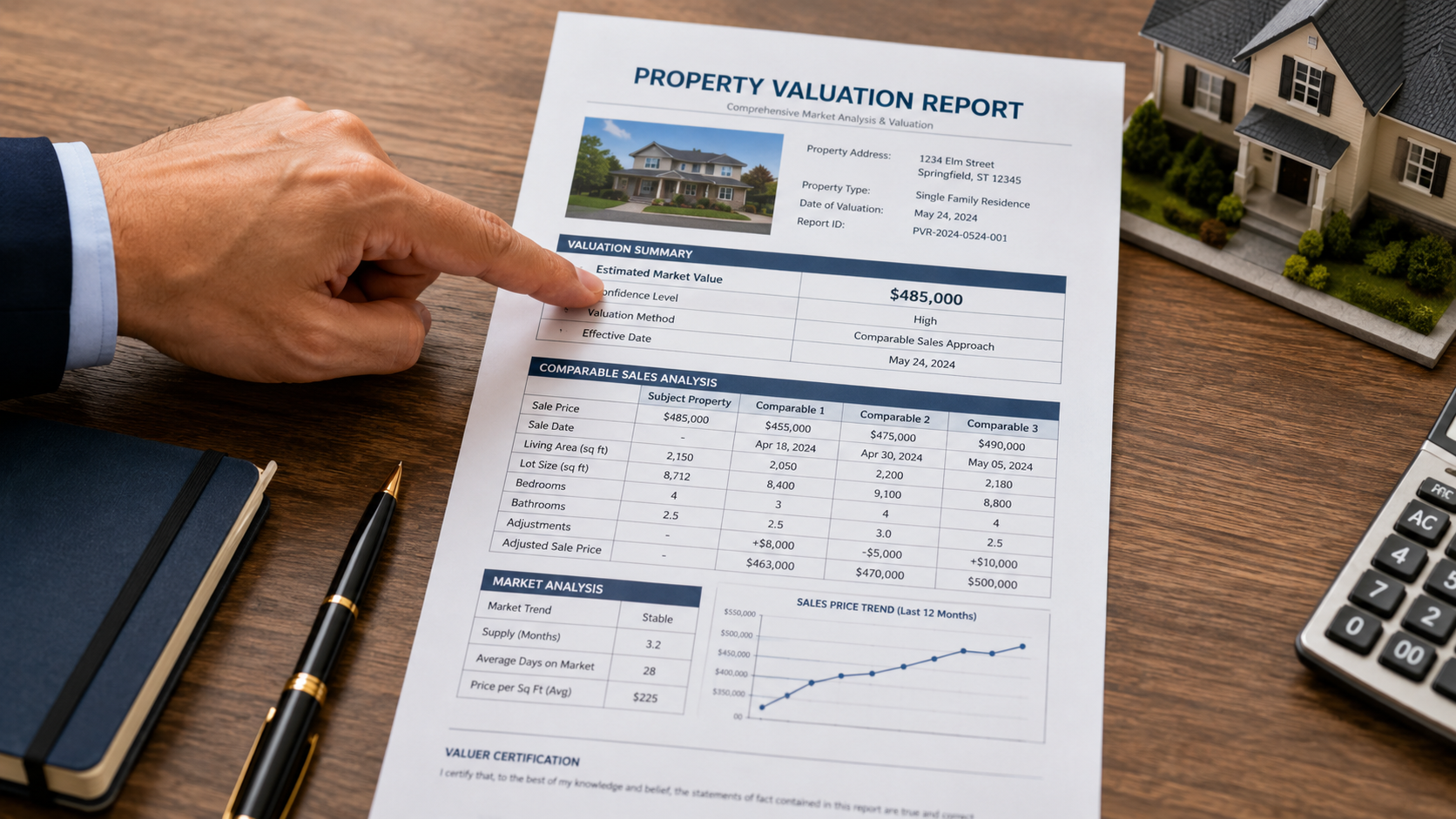
Frequently asked questions about home valuation in India
"Can I use a Zillow estimate for a home loan in India?"
No, absolutely not. Indian banks require a valuation report from a government-approved valuer. Zillow's estimate has no standing.
"How often should I get my home re-valued?"
It's a good idea to get your home re-valued every 2-3 years, or whenever market conditions in your area change significantly. This is especially true if you're planning to sell or need it for tax purposes.
"Is a government-approved valuation expensive?"
The cost typically ranges from ₹3,000 to ₹10,000, depending on your property's size and complexity. This is a small investment compared to the potential costs of an incorrect valuation, especially for capital gains tax.
"Does Rao Valuers cover all Indian cities?"
Yes, we have a pan-India network of approved valuers, so we can assist you no matter where your property is located.
Ready to get a reliable, government-approved valuation for your property in India? Avoid the guesswork and ensure your valuation is accepted everywhere it needs to be. A professional valuation is not just a formality, it's a critical financial tool that protects your assets and ensures compliance in India's dynamic property market.
Get a Free Valuation Quote from Rao Valuers Today
Checked by Parish Rao, Chartered Engineer and Government Approved Valuer.
Page last checked on 3 September 2026.
Get a free valuation quote
Tell us what you need valued. We will message you on WhatsApp with which report you need and what it costs, free of charge.
In a hurry? Call +91 98681 69747 instead.